Disclaimer: This article is provided for general informational purposes only and does not constitute formal legal, professional, or administrative advice. Readers should consult qualified staff representation, staff union, or legal counsel regarding individual institutional circumstances.
Key Takeaways
- Preserve raw digital files rather than screenshots: The Investigation and Disciplinary Office of the Commission (IDOC) and EU selection/disciplinary boards can easily dismiss cropped screenshots or copy-pasted text, requiring native
.eml/.msgfiles with complete internet headers to establish authenticity. - Secret audio recordings carry severe disciplinary risks: While national laws in Belgium or Luxembourg may tolerate single-party audio recordings under specific conditions, EU statutory case law treats covert workplace recordings as a breach of loyalty (Article 11 and Article 21 Staff Regulations) and a violation of Regulation (EU) 2018/1725, which can lead to counter-inquiries against you.
- Medical certificates establish health injury, not legal guilt: A certificate from a private physician diagnosing “burnout due to harassment” proves work incapacity under Article 59, but EU courts do not accept it as binding proof that harassment legally took place under Article 12a.
- Invalidity and harassment procedures run on parallel tracks: Proceedings before the Invalidity Committee (Article 78) or occupational disease claims (Article 73) assess medical causation and financial entitlements, functioning independently from IDOC disciplinary investigations into the alleged perpetrator.
This article is primarily relevant to EU staff employed in Brussels and Luxembourg. However, most of it will also be of interest to staff in other EU institutions and agencies.
Executive Summary
All references to articles are related to Staff Regulations unless indicated otherwise.
Navigating workplace conflict, psychological harassment (Article 12a), or whistleblowing procedures (Article 22a–c) in EU institutions requires far more than subjective allegations. To trigger an administrative inquiry by Investigation and Disciplinary Office of the Commission (IDOC) or secure formal assistance from the Appointing Authority (AIPN) under Article 24 of the Staff Regulations, a staff member must establish prima facie (sufficiently apparent) evidence.
Many staff unintentionally sabotage their own cases by relying on flawed evidence-gathering methods. Cropped mobile screenshots, forwarded email chains stripped of metadata, and clandestine phone recordings are frequently rejected during preliminary assessments and later legal proceedings. In the worst cases, gathering evidence improperly can violate EU data protection rules (Regulation (EU) 2018/1725), breach internal ICT security policies, or expose the victim to disciplinary proceedings for breach of trust.
This guide provides a manual for gathering and preserving admissible evidence across the European Commission, General Secretariat of the Council, European Parliament, and decentralised agencies. It details the technical steps for extracting unaltered email metadata, exporting messaging app history, building a chronological incident log, navigating the legal complexities of medical boards and JSIS invalidity, and securing witness testimony while avoiding falling into procedural traps.
While I strongly advise seeking peer, psychological and legal help as early as possible in harassment cases, this guide should be useful to orient oneself in a “landscape” most people (thankfully) don’t find themselves too often.
importance of early evidence gathering
To open a formal administrative inquiry under Commission Decision C(2019) 4231 or invoke the duty to assist under Article 24 of the Staff Regulations, the administration does not require definitive proof on day one. It does, however, require prima facie evidence that the alleged hostile, abusive, or irregular behaviour actually took place.
The General Court and Court of Justice of the European Union (CJEU) consistently rule that mere feelings of marginalisation, uncorroborated assertions, or normal administrative tension do not constitute harassment. The evidence submitted must demonstrate repetitive, sustained conduct or a severe breach that objectively damages the dignity or professional standing of the staff member.
Administrative investigators must assess both inculpatory and exculpatory evidence. If your evidentiary file consists of ambiguous or easily tampered elements, the Appointing Authority will dismiss the request for assistance at the preliminary assessment stage, leaving you without institutional protection.
Preserving Email Evidence: Beyond Copy-Paste and Screenshots
Why Simple Copy-Pasting and Screenshots Fail
A standard screenshot or copy-pasted block of email text has almost zero forensic weight in a contested inquiry. Disciplinary investigators and defence counsel can easily argue that plain text has been altered, taken out of context, or fabricated using basic editing tools.
When you forward an email to another address, your mail client generates a brand-new message header that obscures the original transmission path. Forwarding also frequently removes embedded routing data, original digital signatures, and unaltered message server transmission timestamps.
How to Extract Native Message Files (*.eml and *.msg)
Always preserve the email in its raw container format directly from Microsoft Outlook or any other institutional webmail client.
- Outlook Desktop (Windows/Mac): Open the specific message, click File > Save As, and choose Outlook Message Format (*.msg) or RFC 822 Message (*.eml). Alternatively, drag and drop the message directly from Outlook into a dedicated, secure local folder.
- Webmail / Outlook Web App (OWA): Click the three horizontal dots (
...) in the message header, select View > View message details to inspect headers, or choose Save / Download to capture the full raw file.
Preserving Metadata is Key
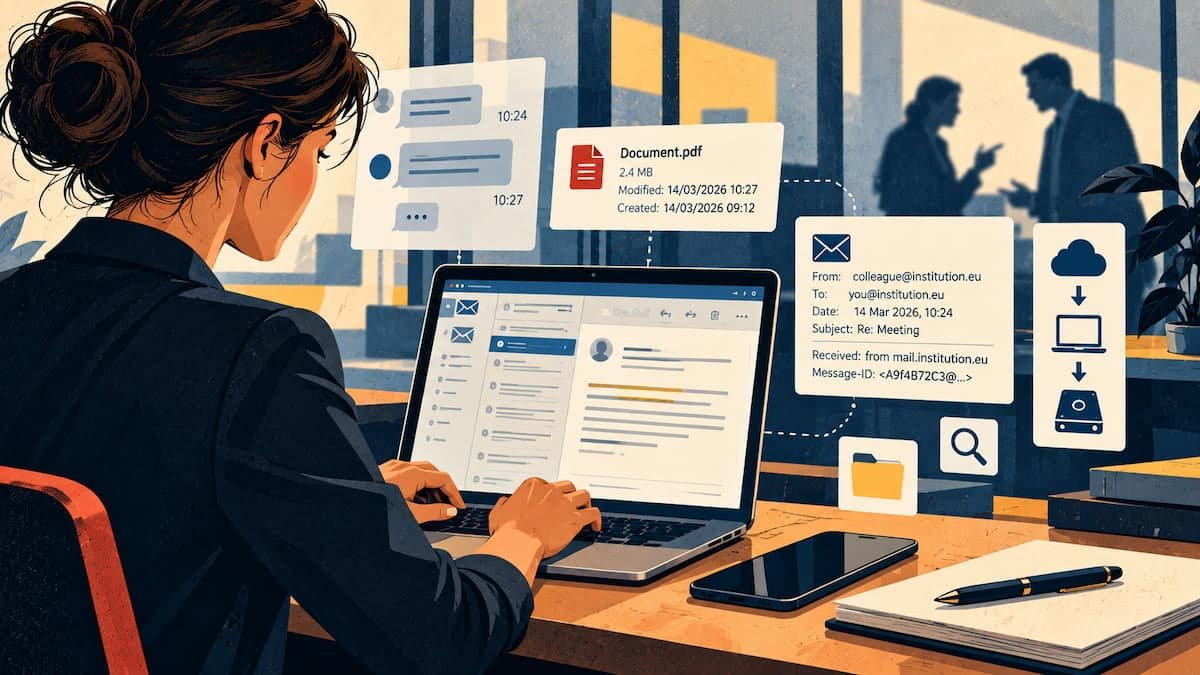
The true legal proof of an email lies in its hidden internet headers and other metadata. These headers contain the immutable digital footprint of the communication, including:
- The unique Message-ID generated by the institutional mail server.
- Exact UTC timestamps for each server relay hop.
- Authentication verification records (DKIM-Signature, SPF, and DMARC results) proving the email originated from the sender’s official account and was not spoofed.
- Sender and recipient account identifiers, IP addresses, and routing directives.
To export these headers in Outlook, double-click the email to open it in its own window, go to File > Properties, and copy the entire contents of the Internet headers text box. Paste this into a plain text document (.txt) alongside the saved .msg file.
Navigating Institutional IT Security and Confidentiality Rules
Exporting institutional documents to private devices or cloud drives can trigger allegations of non-compliance with Article 17 of the Staff Regulations (unauthorised disclosure of information) or internal EU institution’s security rules.
Keep your evidence archive organised within a secure, dedicated folder on your official work environment, or request guidance from your Data Protection Coordinator (DPC) if external legal counsel requires access.
If you must store files off-site for self-protection, restrict the records strictly to communications directly concerning your personal situation, ensuring no sensitive policy documents or third-party personal data are exported.
Messaging Apps: MS Teams, whatsapp, etc.
Pitfalls of Screenshots
Text screenshots from smartphones or your computer screen are among the most contested pieces of evidence in administrative inquiries. Screenshots are routinely challenged because they omit full phone numbers and email addresses, truncate preceding context, and fail to prove that messages were not altered using readily available mock-up apps.
How to Export WhatsApp and Messaging Data Professionally
If communication with a supervisor or colleague has spilled over into instant messaging, do not rely on isolated screen grabs.
- Native WhatsApp Export: Open the chat thread, tap the contact name/settings, scroll down, and select Export Chat. Choose Attach Media if pictures, voice notes, or documents are part of the evidence. This produces a single, chronological
.txtfile containing exact dates, system timestamps, sender phone numbers, and full message threads. Also set regular back-up of the particular chat so that you can recover it in case the other party has deleted its messages or metadata are required for forensic or other technical analysis. - Signal and Secure Messengers: Use the local desktop backup function or capture end-to-end chat exports through the application’s built-in export features. Never edit, truncate, or re-save the exported text file, as changing its file properties alters its digital hash.
Best Practices When Screenshots Are Unavoidable
If you must take screenshots of mobile messages, follow a strict forensic capture method:
- Do not crop the screenshot; ensure the device status bar (showing battery percentage, Wi-Fi/cellular indicators, and network-synchronised time) is clearly visible.
- Ensure the other party’s actual telephone number is displayed in the frame, rather than just an editable address-book contact name (if necessary, temporarily delete the contact’s name, so only the phone number identifies the person).
- Capture overlapping frames so that the bottom text of the first screenshot appears at the top of the next, proving unbroken continuity.
- Supplement screenshots with a continuous screen-recording video (or recording with another device) scrolling slowly through the entire conversation history.
Managing Microsoft Teams and Skype for Business Logs
Within EU institutions, internal harassment or bullying often occurs across Microsoft Teams chats and calls, and similar channels.
Teams chat history is hosted on your institution’s enterprise Microsoft 365 tenant, meaning access can be abruptly lost if you are placed on administrative leave, reallocated to another DG, or if your contract terminates. Furthermore, standard tenant retention policies may automatically purge direct messages after a predetermined period.
Take immediate action to preserve Teams interactions:
- Open the conversation in Teams, select the thread, and use your browser/system print dialogue to Print to PDF, ensuring dates and sender profiles remain intact.
- Note down the exact dates, times, and participant usernames so you can formally request an eDiscovery extraction or audit log preservation through your institution’s Data Protection Officer (DPO) under Regulation (EU) 2018/1725.
Audio and Video Recordings: A risky action and a possible legal Trap
National Law vs EU Staff Regulations
Many staff members assume that because recording a conversation you participate in is not a criminal offence under single-party consent rules in certain Member States (such as Belgium), it is automatically permissible at work. This can be a counterproductive conception.
EU administrative tribunals and institutional inquiry boards do not operate solely under national penal codes; they also operate under the legal order of the EU Staff Regulations.
Why Secret Workplace Recordings Can Backfire
Clandestine recordings of colleagues or managers within EU premises present severe administrative risks:
- Breach of the Duty of Loyalty (Articles 11 and 21): The General Court has consistently affirmed that secretly recording professional discussions destroys the necessary mutual trust between an official and the administration, amounting to serious misconduct.
- Violation of Data Protection (Regulation (EU) 2018/1725): Recording another individual’s voice and spoken remarks constitutes the processing of biometric and personal data without a valid legal basis or data subject notice.
- Risk of Disciplinary Inquiries Against You: Complainants who submit covert recordings to IDOC can find that the Appointing Authority opens a counter-inquiry against them for unauthorised recording and breach of professional confidentiality.
- Low Evidentiary Weight: Even where a court exercises discretion under the principle of unfettered evaluation of evidence, clandestine recordings are viewed with extreme suspicion and may be ruled inadmissible if deemed disproportionate or intrusive.
A Legal Alternative to Recordings: Contemporaneous Written Confirmations
Instead of recording meetings covertly, deploy the contemporaneous email recap strategy. This method creates admissible documentary proof without breaching statutory obligations.
Within a few hours of any hostile verbal interaction, bilateral meeting, or controversial phone call, send a polite, professional, and purely factual email to the individual:
“Dear [Name], thank you for our meeting earlier today at 10:00. To ensure complete alignment on work priorities, I am writing to confirm my understanding of the instructions given: [insert factual summary of instructions, remarks, or decisions]. Please let me know if anything has been captured inaccurately.”
If the recipient fails to challenge your written summary, their silence or evasive reply provides strong contemporaneous documentary evidence (preuve par écrit) that can be safely submitted to IDOC or the mediation service.
Medical Evidence
Medical Certificates vs Legal Proof of Harassment (Article 59)
A common misunderstanding among EU staff is assuming that a medical certificate diagnosing “burnout caused by workplace harassment” legally proves that harassment occurred. Under established EU case law, a treating physician or psychiatrist certifies medical incapacity for work under Article 59 of the Staff Regulations, but cannot legally determine whether the events at work satisfy the statutory definition of Article 12a on harassment.
Because external doctors base their diagnoses largely on the narrative provided by the patient, disciplinary bodies and IDOC investigators treat medical certificates as proof of clinical harm rather than proof of the respondent’s administrative guilt. The administration will verify whether medical absences correlate chronologically with specific workplace events, but independent corroboration of the behaviour remains indispensable.
Furthermore, submitting extended medical certificates citing workplace conflict can prompt the institution to order a medical control (contrôle médical). If the Medical Service’s independent doctor disputes the fitness assessment, an arbitration procedure is initiated, which operates strictly on medical grounds separate from your harassment complaint.
Occupational Disease Linked to Harassment
When psychological health collapses under sustained workplace mistreatment, officials often lodge an application under Article 73 of the Staff Regulations to recognise their condition (such as reactive depression or PTSD) as an occupational disease (maladie professionnelle). Article 73 provides significant statutory protection, including full medical reimbursement under JSIS and capital lump sums for permanent partial invalidity.
Crucially, the Court of Justice has confirmed that Article 73 recognition procedures and Article 12a harassment proceedings are legally independent tracks. A medical board evaluating an Article 73 claim can conclude that an illness has an occupational origin caused by workplace stress or management friction, even if IDOC finds that the supervisor’s actions did not reach the threshold of intentional, illegal harassment.
Conversely, having an IDOC finding of harassment does not automatically grant an Article 73 award. The claimant must independently prove to the medical experts that the workplace events were the direct and essential cause of the medical impairment, which can be fiercely challenged if pre-existing psychological conditions exist.
Invalidity Board
If a staff member remains on protracted sick leave and cannot return to service, either the institution or the staff member may initiate proceedings before the Invalidity Committee (Commission d’invalidité) under Article 78 and Annex II, Section 3. This committee consists of three medical practitioners: one appointed by the institution, one by the official, and one chosen by mutual agreement between the two doctors.
The Invalidity Committee’s mandate is purely medical: determining whether the official suffers from a permanent, total incapacity preventing them from performing their duties. If total invalidity is confirmed, the official is retired from active service and granted an invalidity allowance equal to 70% of their final basic salary (with minimum thresholds set by Article 6 of Annex VIII).
However, entering the invalidity stream can create a practical risk for an ongoing harassment inquiry. Once a staff member is retired on invalidity (which can happen before a harassment case is finalised), the administration’s institutional incentive to pursue disciplinary sanctions against the harasser drops drastically, while the victim’s physical access to internal databases, work emails, and colleagues can be limited or permanently terminated.
Medical Secrecy vs IDOC Evidence Access
Strict medical confidentiality shields the clinical files, therapy notes, and medical committee deliberations of the Medical Service and JSIS from IDOC investigators and the Appointing Authority. Investigators cannot demand access to your psychiatric evaluations, nor can the Appointing Authority use raw medical files against you in an inquiry without your express written waiver.
The administration receives only the operative medical conclusions—namely, whether the official is fit or unfit for work, whether invalidity is total, and whether an occupational link was affirmed. To introduce psychiatric trauma as proof of harm in a formal Article 24 request, the staff member must voluntarily provide tailored medical summaries that substantiate health impacts without disclosing unrelated private medical history.
Securing Witness Statements and Third-Party Corroboration
Legal Safeguards Under Article 12a(2)
Article 12a(2) of the Staff Regulations explicitly stipulates that officials and other servants who provide evidence or act as witnesses in cases of psychological or sexual harassment shall not suffer any prejudicial treatment by the institution.
This provision offers statutory immunity against retaliatory appraisals, blocked promotions, or contract non-renewals for participating in an inquiry.
The Institutional Reality: Reluctance and Career Preservation
Despite legal protections, colleagues are often extremely hesitant to intervene formally. Contract Agents (CAs) and Temporary Agents (TAs) are particularly vulnerable due to fear that speaking out against a middle or senior manager will result in non-renewal of their contracts.
How to Collect Statements Without Breaking Rules
To approach potential witnesses ethically and legally:
- Never organise group petitions: Circulating joint letters or organising collective complaints within a unit can be construed as insubordination, disruption of the service, or collective harassment against the manager.
- Ask for personal factual recollections: Request that a colleague write down what they specifically heard or observed during an open meeting, limiting their statement strictly to direct sensory facts rather than emotional evaluations.
- Direct them to confidential mechanisms: Encourage colleagues to speak directly with an appointed Confidential Counsellor (Conseiller Confidentiel), an institutional Mediator, or an IDOC investigator during formal interviews, where their testimony is logged into the official record under procedural safeguards.
keeping track of Evidence: Incident Log
A disorganised collection of hundreds of mixed files will dilute your case. Investigators review dozens of files simultaneously and require a coherent chronological narrative to establish the pattern of behaviour.
Create a log or register where you note each episode linked to harassment. A suggested template is provided below:
| Incident # | Date & Time | Location / Medium | Factual Description of the Event | Direct Witnesses | Corroborating Evidence File | Procedural Impact / Harm |
| 01 | 12/03/2026 10:15 | Unit Meeting (Room SPA3 04/12) | Unjustified public reprimand; tasks removed without explanation. | J. Dupont, M. Rossi | DOC01_Meeting_Minutes.msg | Demotion of duties; medical sick leave. |
| 02 | 18/03/2026 14:30 | MS Teams Direct Message | Threatening contract non-renewal if overtime query escalated. | None (Bilateral) | DOC02_Teams_Export.pdf | Psychological stress; consultation with JSIS doctor. |
| 03 | 25/03/2026 16:00 | Bilateral Office SPA3 04/45 | Verbal instruction contradicting official written guidelines. | None | DOC03_Email_Recap.msg | Task execution compromised. |
Store your supporting documents in folder and name them according to the file name in the log file.
weight of different evidence formats
The table below outlines how different types of workplace evidence might be evaluated by IDOC, institutional appointing authorities, and the EU General Court.
| Evidence Type | Admissibility Level | Technical Authenticity | Counter-Risk for Complainant | Recommended Best Practice |
| Native Email (.msg/.eml with headers) | Very High | High (Cryptographic server verification via DKIM/SPF) | None (Legitimate administrative record) | Save directly from Outlook. |
| Contemporaneous Written Recap | Very High | High (Verifiable send/receive timestamps) | None (Standard professional communication) | Send within hours of verbal interaction; keep tone neutral. |
| Messaging Apps Raw Chat Export | Moderate to High | Moderate (Plaintext log with system time) | Low (If limited to personal communications) | Export unedited chat thread with media; make a backup; keep source device intact. |
| Cropped Mobile Screenshots | Low to Moderate | Low (Vulnerable to claims of tampering or missing context) | Low | Use full uncropped screen captures, scrolling video, or replace with raw export. |
| Secret Audio/Video Recording | Very Low / Excluded | Moderate (Requires forensic timestamping) | Severe (Disciplinary inquiry for breach of trust under Art. 11/21) | Avoid entirely. Replace with immediate written recaps or open meeting minutes (or only use as private aid memoire). |
| Individual Witness Statements | High | High (Signed and corroborated during hearings) | Low (Statutory protection under Art. 12a) | Request individual statements; direct witnesses to mediators/investigators. |
| Treating Doctor Certificate (Art. 59) | Moderate | High (Formal medical document) | Low | Use strictly to prove clinical damage and period of incapacity, not to prove guilt of the harasser. |
| Invalidity Board / Art. 73 Decision | High (for injury/causation) | High (Statutory collegiate expert decision) | Moderate (Triggers career exit; cuts internal IT evidence access) | Preserve evidence before entering invalidity; link medical causation explicitly to facts in the incident log. |
Practical Action Plan: What to Do Next
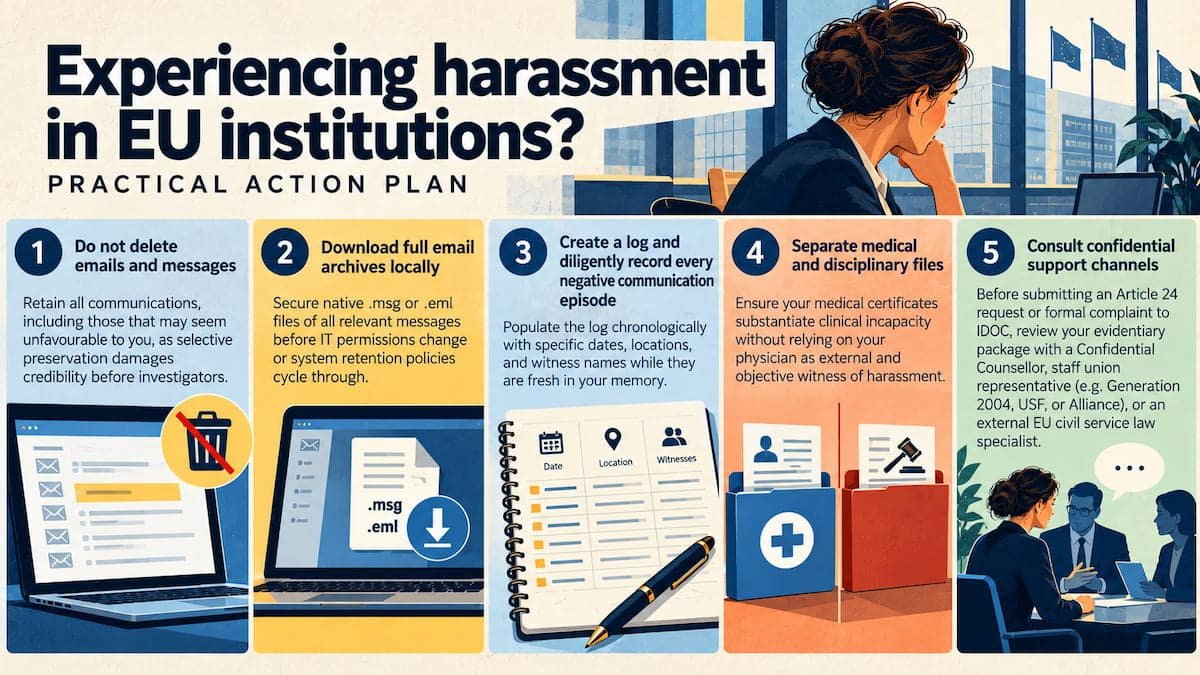
If you are experiencing workplace harassment, discrimination, or preparing a whistleblowing report in an EU institution:
- Do not delete emails and messages: Retain all communications, including those that may seem unfavourable to you, as selective preservation damages credibility before investigators.
- Download full email archives locally: Secure native
.msgor.emlfiles of all relevant messages before IT permissions change or system retention policies cycle through. - Create a log and diligently record every negative communication episode: Populate the log chronologically with specific dates, locations, and witness names while they are fresh in your memory.
- Separate medical and disciplinary files: Ensure your medical certificates substantiate clinical incapacity under without relying on your physician as external and objective witness of harassment.
- Consult confidential support channels: Before submitting an Article 24 request or formal complaint to IDOC, review your evidentiary package with a Confidential Counsellor, a staff union representative (e.g. Generation 2004, USF, or Alliance), or an external EU civil service law specialist.