
Last updated on 26 October 2026
Executive summary

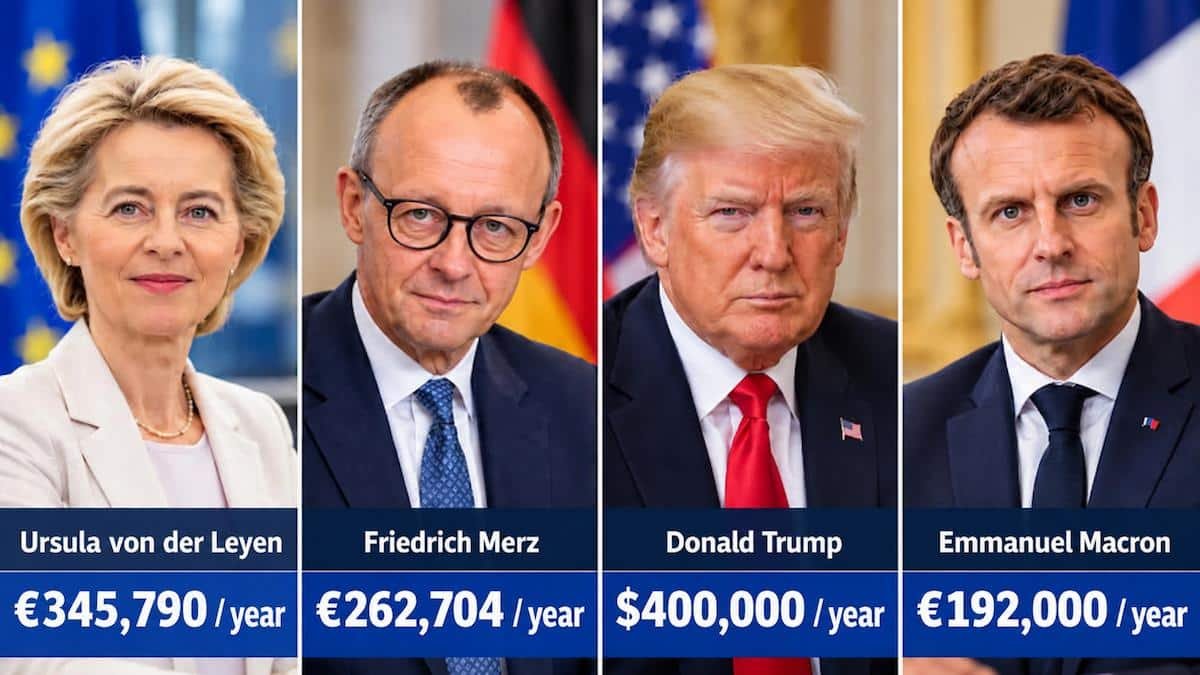
The net salary of Ursula von der Leyen is ~EUR 28,816 per month or ~EUR 345,790 per year. The figures include standard monthly allowances and such deductions as EU taxes and social contributions. As other EU institutions staff, the European Commission President does not pay national taxes from her EU salary.
Main salary components:
- Basic Monthly Salary: EUR 35,860.91 (EUR 430,330.92 / year)
- Total Monthly Allowances: + ~EUR 7,755.64 (Residence, Household, and Entertainment allowances)
- Total EU Taxes & Deductions: – ~EUR14,800.73 / month
- Estimated Net Take-Home Pay: ~EUR 28,816 / month (~EUR 345,790 / year)

Comparison with other top political leaders
This section shows how the European Commission President’s salary compares to salaries of top political leaders. Unlike national heads of state or government, however, the Commission President does not receive a free state residence or full household staff. Ursula von der Leyen has to cover her living and representational expenses from her salary and allowances.
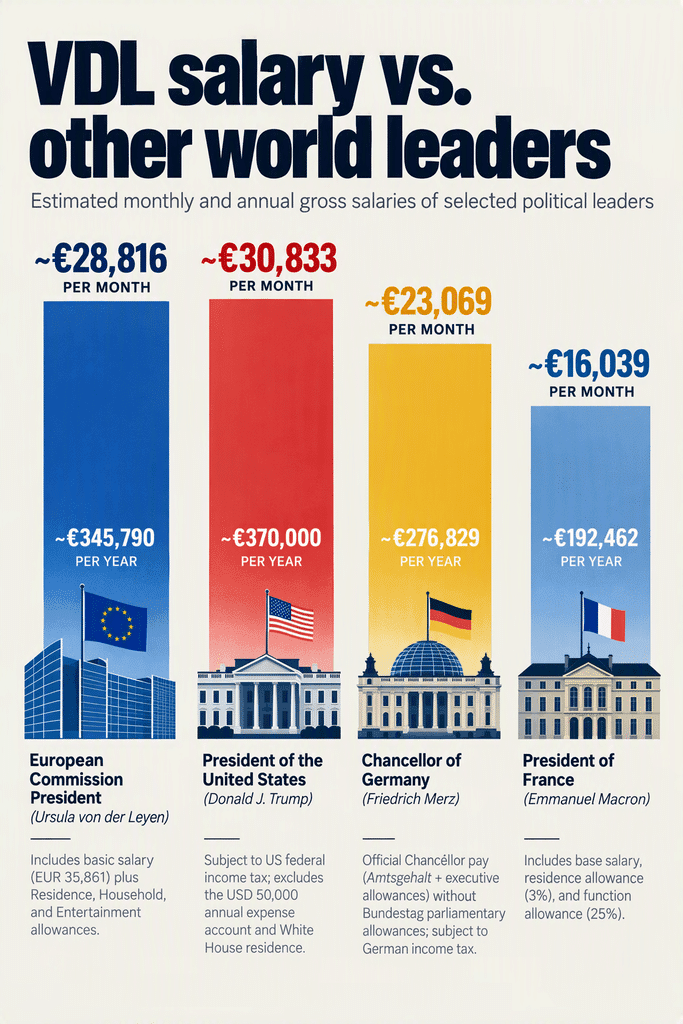
The German Federal Chancellor receives a statutory base salary (Amtsgehalt) of ~EUR 20,675.42 per month (~EUR 248,105 per year), which increases to ~EUR 23,069.10 per month (~EUR 276,829 per year) when standard executive allowances (local, job, and official expense allowances) are included, excluding any Bundestag member remuneration. Meanwhile, the President of the United States earns a nominal gross salary of USD 400,000 per year (around EUR 370,000, plus a USD 50,000 expense account), and the President of France receives a gross monthly salary of ~EUR 16,038.54 (~EUR 192,462 per year).
| Executive Leader | Monthly Gross Salary | Annual Gross Salary | Notes on Compensation Structure |
| European Commission President (Ursula von der Leyen) | ~EUR 28,816 | ~EUR 345,790 | Includes basic salary (EUR 35,861) plus Residence, Household, and Entertainment allowances. |
| President of the United States (Donald J. Trump) | ~EUR 30,833 | ~EUR 370,000 | Subject to US federal income tax; excludes the USD 50,000 annual expense account and White House residence. |
| Chancellor of Germany (Friedrich Merz) | ~EUR 23,069 | ~EUR 276,829 | Official Chancellor pay (Amtsgehalt + executive allowances) without Bundestag parliamentary allowance; subject to German income tax. |
| President of France (Emmanuel Macron) | ~EUR 16,039 | ~EUR 192,462 | Includes base salary, residence allowance (3%), and function allowance (25%). |

Monthly salary breakdown
Calculating remuneration in EU institutions is not simple because several statutory allowances and internal deductions affect the final take-home figure. The table below summarizes every monthly component applicable to the President of the European Commission under current EU rules.
| Remuneration Component | Statutory Rule / Formula | Monthly Amount (EUR) |
| Basic Salary | 138% of Grade AD 16, Step 3 (EUR 25,986.17) | EUR 35,860.91 |
| Residence Allowance | 15% of basic salary | + EUR 5,379.14 |
| Household Allowance | EUR 241.21 + 2% of basic salary | + EUR 958.43 |
| Entertainment Allowance | Fixed statutory amount for the Commission President | + EUR 1,418.07 |
| TOTAL GROSS REMUNERATION | Basic salary plus monthly allowances | EUR 43,616.55 |
| EU Community Tax | Progressive (8% to 45% above EUR 9,815); effective rate 32.47% | – EUR 11,644.97 |
| Solidarity Levy | 7% of basic salary (statutory rate for top grades) | – EUR 2,510.26 |
| Health Insurance (JSIS) | 1.70% of basic salary | – EUR 609.64 |
| Accident Coverage | 0.10% of basic salary | – EUR 35.86 |
| Pension & Unemployment Contributions | Funded directly from the EU budget (Art. 13 Reg. 2016/300) | EUR 0.00 |
| ESTIMATED NET MONTHLY SALARY | Take-home pay after statutory deductions | EUR 28,815.82 |
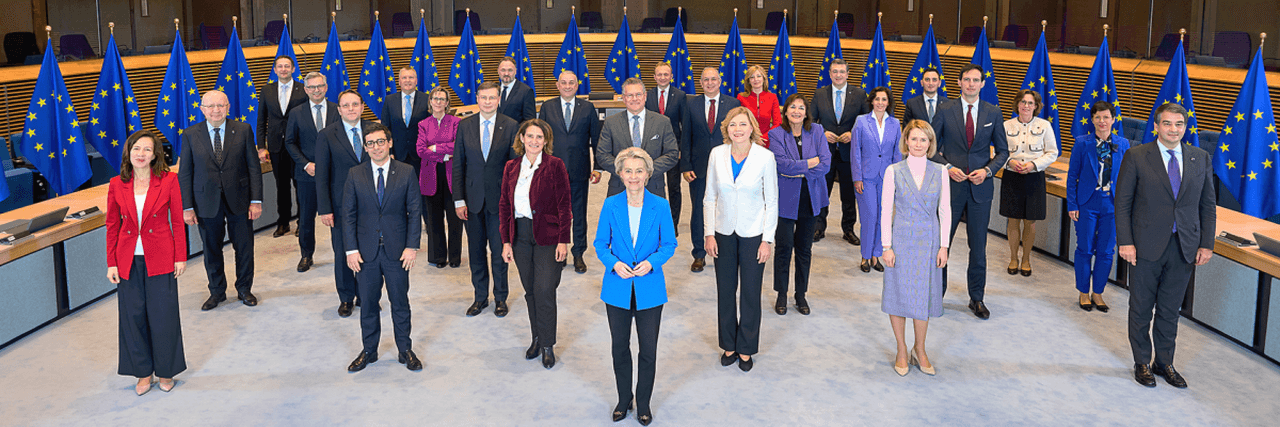
College of Commissioners (2025-2029). Source: European Commission
Salaries of EU Commissioners in von der Leyen’s 2nd Commission (2024–2029)
Every member of the College of Commissioners receives a remuneration package calculated from the same civil service baseline, though at lower percentage multipliers than the President. Click on any Commissioner below to see their specific salary breakdown, or view the short biographies of each Commissioner on Politico.eu.
Salaries of EU Commissioners in VDL’s 2nd Commission (2024-2029)
Short BIO of each Commissioner from Politico.eu.
Basic salary
When examining how salaries of EU officials are calculated, the starting point is always the basic salary. However, the actual take-home remuneration package consists of several additional components and varies depending on an official’s family status and relocation to Brussels.
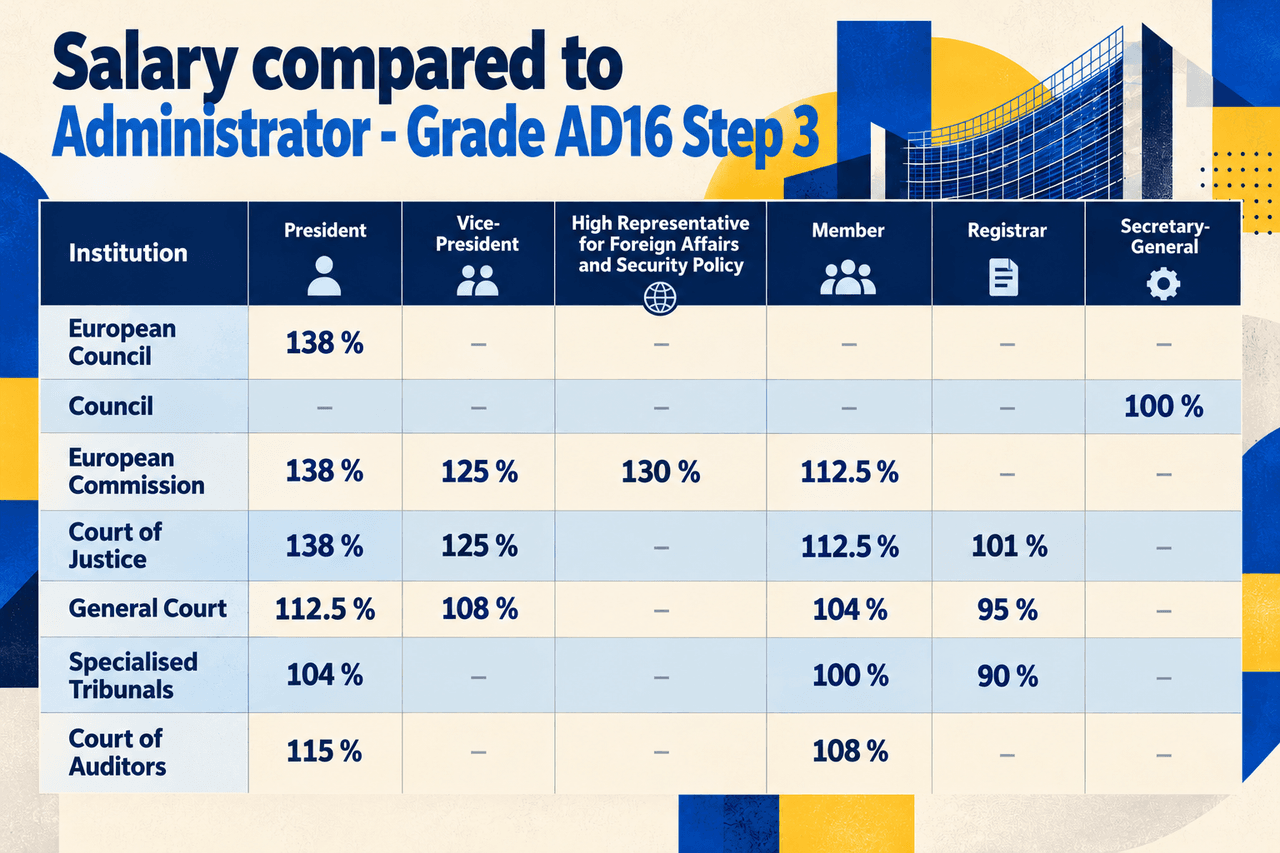
Ursula von der Leyen is entitled to a monthly basic salary of 138% of the top EU civil service grade, which equals EUR 35,860.91. This 138% multiplier is applied to the basic salary of an official on the third step of grade AD 16.
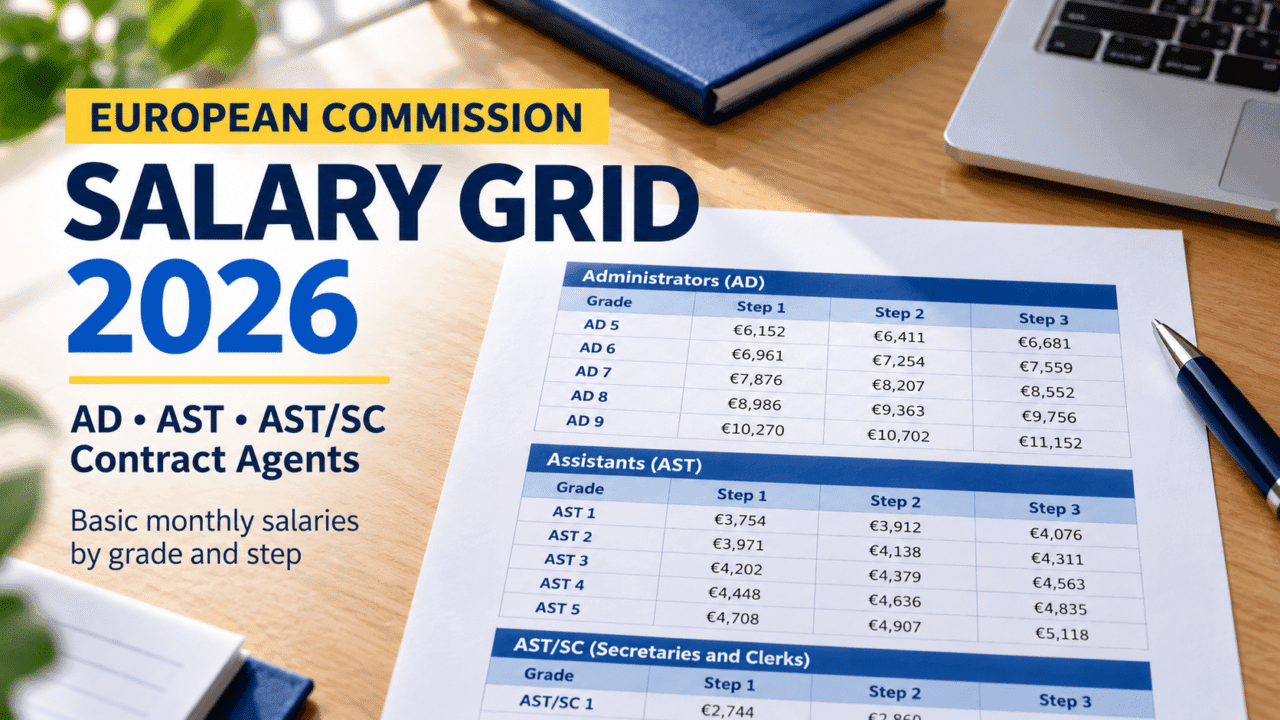
Grade AD 16, Step 3 represents the highest basic salary possible for non-political civil service posts in EU institutions, such as Directors-General in the European Commission. Following the annual remuneration update effective from 1 July 2025, this highest EU civil servant basic salary is EUR 25,986.17 per month.
Source: Article 66 of the EU Staff Regulations | See the full European Commission salary grid
Allowances and other monthly payments
As President of the European Commission, Ursula von der Leyen is entitled to several additional monthly allowances. These payments compensate for relocation to Belgium, and representational duties. EU officials with dependent children would also receive some additional allowances, which we believe do not apply to Ursula von der Leyen.
Residence allowance
High-level EU public office holders receive a Residence Allowance equal to 15% of their basic salary for the duration of their mandate. For the European Commission President, this adds EUR 5,379.14 per month and functions similarly to the expatriation allowance paid to regular EU staff.
Household allowance
Married office holders receive a Household Allowance equal to EUR 241.21 plus 2% of their basic salary. For Ursula von der Leyen, this allowance amounts to EUR 958.43 per month.

Entertainment allowance
Members of the College of Commissioners receive a flat-rate monthly payment officially named the Entertainment Allowance. This allowance covers the costs of work-related hospitality, diplomatic lunches, and representational expenses.
The statutory payment ranges from EUR 607.71 for regular Commissioners and EUR 911.38 for Vice-Presidents to EUR 1,418.07 per month for the European Commission President.
Dependent child and education allowances
EU office holders are also entitled to a Dependent Child Allowance of EUR 527.06 per month per eligible child and an Education Allowance of up to EUR 357.62 per month for children in full-time education. Because Ursula von der Leyen’s seven children are already adults, neither allowance is included in her remuneration calculation.

Taxes and deductions
Exemption from national income taxes
Like all officials and servants of the European Union, the President of the European Commission does not pay national income taxes on her EU salary or allowances. This exemption is established under Protocol No 7 on the Privileges and Immunities of the European Union to prevent double taxation and ensure equal net pay across nationalities.
EU Community Tax
Instead of national taxes, high-level EU office holders pay the EU Community Tax directly into the EU budget. This tax ranges from 8% to a maximum rate of 45%.
The top 45% rate applies to all monthly taxable income above EUR 9,814.62. The monthly Community Tax deduction for Ursula von der Leyen is EUR 11,644.97.
Solidarity Levy
High-level office holders also pay the Solidarity Levy. While regular EU staff pay a 6% levy, officials whose basic salary is at or above Grade AD 15, Step 2 are subject to a 7% rate, which deducts EUR 2,510.26 per month from the President’s pay.
Health insurance (JSIS)
Members of the College of Commissioners are also covered by the EU institutions’ Joint Sickness Insurance Scheme (JSIS). The mandatory Health Insurance Contribution is 1.70% of the basic salary, which equals EUR 609.64 per month.
Accident coverage
Public office holders are also covered against occupational disease and accidents. The Accident Coverage Contribution is 0.10% of the basic salary, which deducts EUR 35.86 per month.
Pension and post-mandate payments
EU pension entitlement
Commissioners are entitled to a lifelong EU pension upon reaching the statutory pensionable age, which is currently set at 66 years. Unlike regular EU staff—who must complete at least 10 years of service and pay a 10.10% monthly pension contribution—Commissioners qualify from their first day in office and make no monthly pension contributions, as their pensions are funded directly from the EU budget.
How Ursula von der Leyen’s pension is calculated
A Commissioner’s pension accrues at twice the annual rate applicable to regular EU officials under Article 77 of the Staff Regulations (1.80% x 2=3.6%) of their final basic salary for every full year in office. In practice, this means Ursula von der Leyen has accrued a pension of 18% (EUR 6,454.96 per month) after her first five-year term, which will rise to 36% of her last basic salary (EUR 12,909.93 per month) if she completes her full 10 years in office in 2029.
You can read more about how these rules compare to standard civil service retirement benefits in our guide to regular pension benefits for staff of EU institutions.

Transitional allowance after leaving office
Instead of standard unemployment insurance, Members of the College of Commissioners receive generous transitional allowances after leaving office. The duration of this monthly payment equals the length of their period of service, subject to a minimum of 6 months and a maximum of 2 years.
The payment ranges from 40% to 65% of the basic salary they received when leaving office, depending on years served. After completing one 5-year term, the entitlement is 50% (EUR 17,930.46 per month for two years), and after two 5-year terms totaling 10 years, it increases to 55% (EUR 19,723.50 per month for two years).
If a former Commissioner takes up new paid employment during those two years, any amount by which their new gross salary plus the transitional allowance exceeds their former Commissioner remuneration is deducted from the allowance. You can read more about standard staff coverage in our guide to regular unemployment benefits for staff of EU institutions.
Office and living arrangements in Brussels

The 13th floor of the Berlaymont
The European Commission’s headquarters is the Berlaymont building at Rue de la Loi 200 in Brussels, Belgium. The President’s office is located on floor 13, the top floor of the Berlaymont, placing the President at the physical top of the European Commission’s hierarchy.
A modest office with a private retreat
Official photographs show that the interior of the European Commission President’s office is relatively modest compared to the state residences of national heads of government. Each incoming Commission President selects the office artwork and furniture from existing institutional collections.
When Ursula von der Leyen took office in 2019 and announced that she would live in the Berlaymont during working weeks, public reports highlighted an adjacent 25-square-meter private room attached to her office. Known among Commission staff as a “personal retreat,” this private space includes a bedroom and a shower.
Background information and legal sources
Basic salary coefficients for high-level office holders
The table below shows the statutory basic salary multipliers for members of the European Commission and other EU institutions. These percentages are applied directly to the Grade AD 16, Step 3 basic salary (EUR 25,986.17).
Official documentation and data sources
- Emoluments of EU High-Level Public Office Holders: Governed by Council Regulation (EU) 2016/300 of 29 February 2016, which establishes the salaries, allowances, transitional payments, and pensions of the European Commission President, Commissioners, and EU Court judges.
- 2025/2026 EU Salary Grid Update: Official Journal of the European Union, C/2025/6564 (11 December 2025), updating the basic monthly salaries and family allowances under the EU Staff Regulations from 1 July 2025.
- International Executive Salaries: German Chancellor figures are sourced from Section 11 of the German Federal Ministers Act (Bundesministergesetz) and Attachment IV to the Federal Law on Salaries of Officers (Bundesbesoldungsgesetz); French President figures from the Projet de loi de finances / Decree No. 2012-983; US President figures from the US Code (3 U.S.C. § 102).
I wrote this article to make it easier to understand the sometimes complex EU HR and administrative rules. However, your individual case might have unique angles due to prior work experience, family situation, or other factors.
Where to ask questions?
Rather than leaving a comment below, please bring your questions to our Jobs in EU Institutions Facebook Group. We have nearly 10,000 members there, including EU ‘insiders’, so you will receive a much faster and more thorough reply from me and the community.
Looking for weekly ‘Zero EPSO’ vacancies across EU institutions and daily tips?
Follow the Jobs in EU Institutions Facebook Page and join alongside over 6,000 other followers.Best regards, Ben
 Best regards, Ben



11 responses to “What is the salary of Ursula von der Leyen?”
Thanks for putting this together. You’ve made a often-overlooked topic, EU senior officials’ pay, much easier to understand.
Rather than quoting only the base salary of roughly €33,000, you break down the residence, household and entertainment allowances. You also show the Community tax, the solidarity levy and the social security deductions. That gives readers a much closer picture of actual take-home pay, and it is more useful than a simple “monthly salary” figure. The comparison with the US President and the German Chancellor also helps put the number in perspective.
Thanks for the comment, I always appreciate hearing from my readers!
I need to update the article as salaries have increased in the past three years due to inflation-related indexation of all salaries in EU institutions.
I think a lot of people here have no idea what they are talking about: Ursula may be a millionaire, but most EU employees make 3-4000 per month, in a country where a decent flat costs you 2000/month…
Not to mention: to work in the EU most of times you have to change country, learn another 2-3 languages, survive the hellish EU bureaucracy… and all this after you spent at least 8 years in higher education!
Anyway, I agree with Alexander below, it should be much better managed and there should be more control, but on the other hand we are talking about a MASSIVE amount of workers, not easy to keep in line..
For the portuguese complainers: I visited it 25 years ago and it was a wasteland, third world country, whereas now is in many respect light years ahead of many other EU nations – mostly thank to EU funding organised and managed by us “EU parasites”
It is disgusting. We are paid monthly salary and working our arses off, she goes to a meeting and with resting bitch face ignores everything and she gets basic salary and extra allowances to pay for basically everything else she may have, rent childcare, entertainment. Wtf? And you do fuck all.
Omg.
Im a qualified economist in finance and accounting and this is just fucking nonsense, no matter how you put it, it wont make sense and it doesn’t really justify the role you do, sitting in some meetings and not even doing what you were meant to do, serving the demos.
Shouldn’t it be performance based and maybe rated by the people and approved by the people and not them deciding about their own wages? Where is the transparency?
Fucking tyranne.
Total rip off EU – so glad we’re out.
I think they deserve it. Top leadership is not easy
social justice
you people have a nice paycheck, and do nothing for the people, all you want is the money, remember there are people in Europe, who don’t have a condign life, who people must think of the poor people who don’t have anything, you people should have a minor paycheck, why you people need so much money and some people don’t have anything, for example, i live in portugal , because of my age 52 no one in portugal gives me work,portugal is no god, government always styling the for people who don’t have nothing,i have a bad life in portugal, this country is no god
I work and live with 300Euro per month with no help what so ever from my government and no jobs and these Mafiozi gets all this money for what??? What different they do then my government does??? This is atrocious.
DISGUSTING!!!! The EU Mafia bleeds EU citizens; there are 32 000 officils employed by the EU Commission alone and 4000 more in the Parliament. Top salaries are c. 30 000 eur/month & lowest c 2000 eur/month – all tax Free! I’m so glad to be able to keep the Mafia feeling fat thank to my tax euros!
I got my mother working in the EU commission. She gets paid around 3.500€, which is not a lot for the prices that we have here in Belgium