
Updated with figures applicable to 2025-2026.
If you have children and will become an employee of the European Commission or other EU institutions, you will be entitled to the European Commission Dependend Child Allowance.
This allowance is EUR 527,06 per child in Brussels and Luxembourg. As this allowance is adjusted by the Correction Coefficient, it’s amount will differ depending on where your EU institution is located.
General rules
The Dependent Child Allowance is one of the ‘family allowances’ mentioned in the Staff Regulations, along with the a) household allowance and the b) education allowance.
According to Article 67 of the Staff Regulations, the Dependent Child Allowance may be doubled, by special
reasoned decision of the appointing authority based on medical documents establishing that the child concerned has a disability or a long-term illness which involves the official in heavy expenditure. Read more about support in case of disability at EU institutions.
Amount of the allowance is reviewed every year and is usually adjusted proportionally with inflation. You can find the mosts up to date Dependent Child Allowance amount in Article 2 of Annex VII of the Staff Regulations.
Dependent Child Allowance in various EU locations
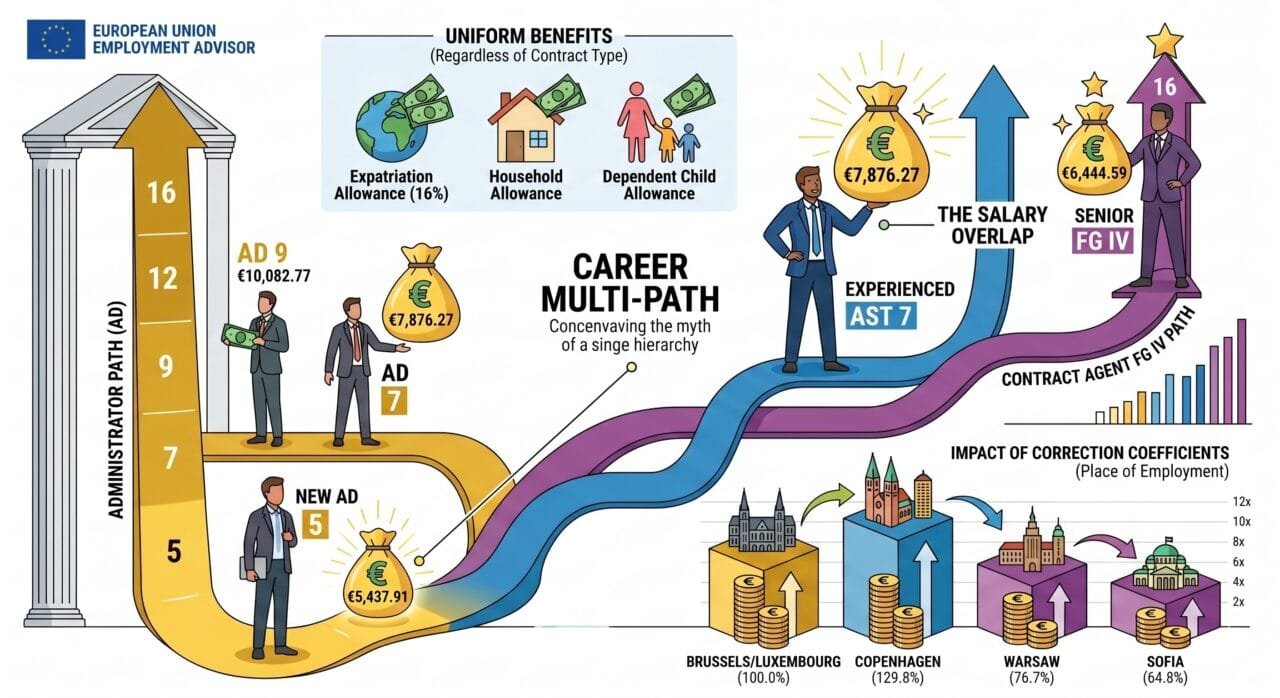
The below table shows you the amounts of the Education allowance in euros depending on the city your EU institution is located in, as the amount is indexed by the Correction Coefficient. The Correction Coefficient adjusts the salaries and allowances of EU institutions staff according to the measured ‘cost of living’ in a particular EU location compared to Brussels.
If you will work in Brussels or Luxembourg, the Correction Coefficient will be 100%. It will be above 100% in Scandinavian countries and lower in Eastern and Central European countries, impacting the actual amount of the allowance you’ll receive.
| Country | Correction Coefficient | Adjusted Dependent Child Allowance |
|---|---|---|
| Ireland | 130.7 | 688.87 |
| Denmark | 129.8 | 684.12 |
| Sweden | 117.7 | 620.35 |
| France | 114.2 | 601.90 |
| Finland | 112 | 590.31 |
| Netherlands | 111.4 | 587.14 |
| Austria | 105.4 | 555.52 |
| Germany | 102.2 | 538.66 |
| Belgium | 100 | 527.06 |
| Luxembourg | 100 | 527.06 |
| Estonia | 93.4 | 492.27 |
| Spain | 92.3 | 486.48 |
| Portugal | 92.1 | 485.42 |
| Malta | 91.8 | 483.84 |
| Czechia | 91.8 | 483.84 |
| Italy | 87.6 | 461.70 |
| Lithuania | 86.7 | 456.96 |
| Greece | 86 | 453.27 |
| Slovenia | 85.9 | 452.74 |
| Slovakia | 84.2 | 443.78 |
| Latvia | 84.1 | 443.26 |
| Croatia | 82.3 | 433.77 |
| Cyprus | 79.4 | 418.49 |
| Poland | 78.8 | 415.32 |
| Hungary | 75.5 | 397.93 |
| Romania | 72.1 | 380.01 |
| Bulgaria | 64.8 | 341.53 |
Payment period and entitlement
The Dependend Child Allowance is generally paid until age of 18 for each child. It can be paid up to age 26, if the child remains in educational or vocational training, and is not gainfully employed.
If both parents work for EU institutions, the allowance is paid to only one of the parents.





4 responses to “Dependent Child Allowance”
What is the maximum amount a child can earn while still being considered dependent on their parents? I have heard of a net amount of roughly €900 per month, a figure that gets adjusted over the years. Is there an official source from the Commission where I can find this information? It’s okay even if the figure isn’t completely up-to-date.
Are children doing (poorly remunerated) medical school specialisation entitled to child allowance? Thank you
The custody agreement determines the amount that I must transfer every month as “child support” (food and clothing) and I would like to know which of these three allowances bellow refers to this same concept.
• Household allowance
• Dependent child allowance
• Education allowance
When the commission decides to send the allowances directly to the custodial parent, what is it based on?
Basically, I need to prove in court that the “dependent child allowance” (or maybe household allowance) is the same that “child support” in the custody agreement.
Don’t treat it as legal advice. I believe that Commission or your EU institution does not decide on anything. If you have children that qualify you for any of these allowances and your former partner is not employed in EU institutions, you will receive all of these allowances. Your EU institution will ensure that a certain part of your salary is transferred to another person’s bank account based on a court order or your own instruction. Please check this with your institution’s HR.