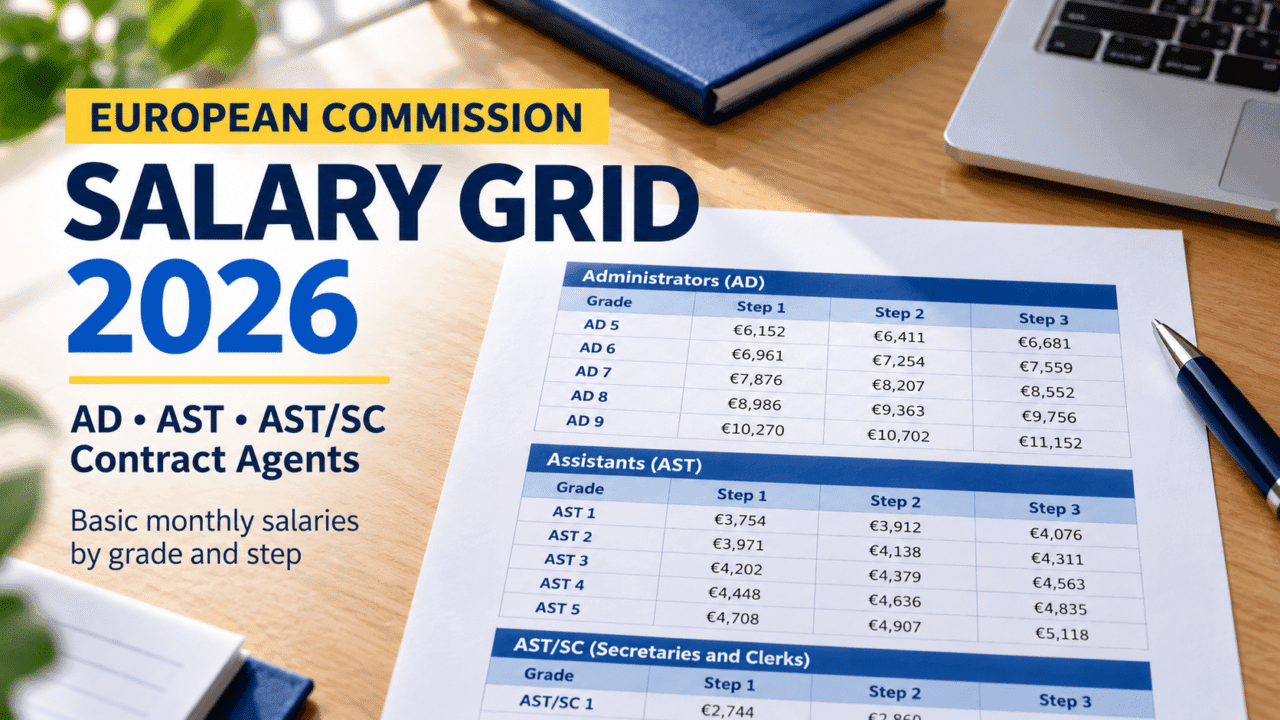

Key Takeaways
- Parity between some grades of AD, AST & CA: senior Contract Agents in Function Group IV Grades 16–18 earn salaries equivalent to mid-level Administrators in grades AD/AST 5-7.
- Uniform Benefits: Expatriation, household, and child allowances are calculated as percentages of basic salary or flat rates, regardless of contract type.
- Correction Coefficients: Your final take-home pay depends more on your ‘place of employment’ (e.g., Copenhagen vs. Sofia) than just your grade.
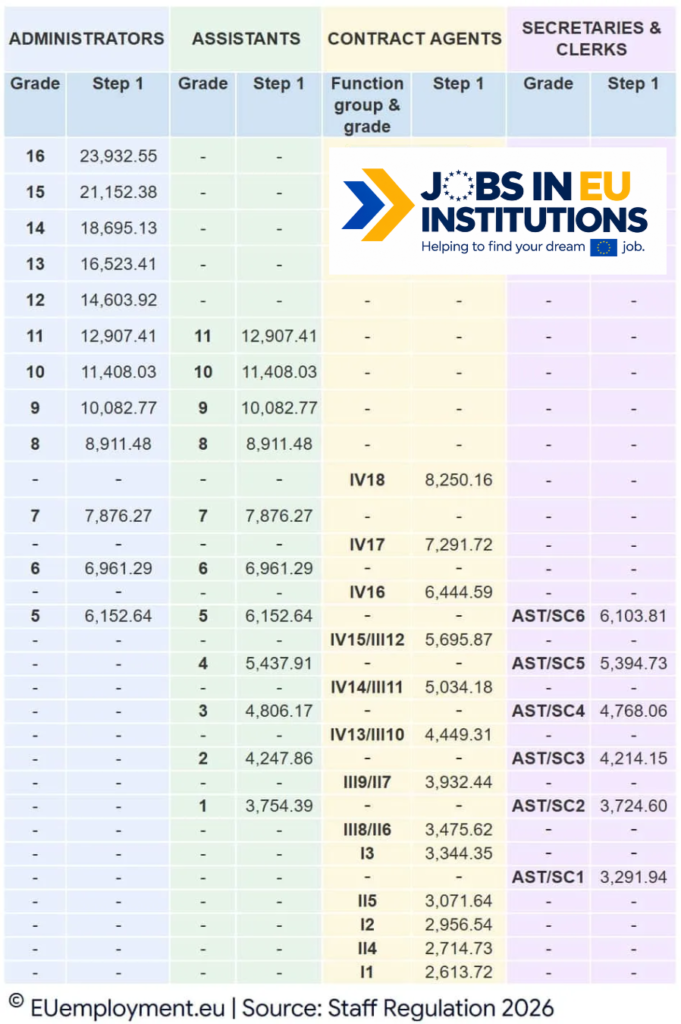
Basic Salaries side to side
Below is a comparison of the basic monthly salaries for different staff categories at comparable levels of seniority or responsibility.
Executive Summary
A common misconception among EU job seekers is that the only path to a “decent” salary is through the Administrator (AD) career path. While AD roles offer the highest long-term ceilings, the salary overlap between categories is significant. As of the July 2025 – June 2026 salary update, a senior Assistant (AST) or a high-level Contract Agent (FG IV) can earn a net income that rivals or exceeds that of an entry-level AD 5 or AD 6 official.
This article deconstructs the salary grid to show that Function Groups and Staff Categories are not strictly hierarchical in terms of pay. We explore how “Assistant” grades 5 to 11 and “Contract Agent” FG IV grades 15 to 18 provide substantial financial stability, especially when family and expatriation allowances are included.
The Myth of the “Administrator Only” Payday
In the EU civil service, your “rank” (AD, AST, or FG) describes your responsibilities, not necessarily a fixed pay ceiling. While an AD 5 official starts with a basic salary of €5,437.91, an Assistant at grade AST 7 (Step 1) earns €7,876.27.
The “insider” reality is that many long-serving Assistants (ASTs) carry immense institutional knowledge and are compensated accordingly. Similarly, Contract Agents in Function Group IV (FG IV) are often experts in their fields, and their salary scale reflects this expertise, starting at grade 13 but extending up to grade 18.
Why Assistants (AST) Can Earn So Much
The AST career path was originally designed for technical and administrative support. However, grades AST 5 to AST 11 are senior positions. By the time an Assistant reaches AST 11, their basic salary is €12,907.41, which is higher than an Administrator at AD 9.
The Rise of the FG IV Contract Agent
Contract Agents in Function Group IV perform the same tasks as Administrators but on fixed-term contracts (usually up to 6 years). If you are hired into Grade 15 or 16 due to significant previous experience (usually 10+ years), your starting basic salary will be higher than that of a newly recruited AD 5 official.
Sample Calculation: Assistant vs. Administrator
Let’s look at a “Real World” comparison of two staff members living in Brussels, both expats, married with one child.
Scenario A: New Administrator (AD 5, Step 1)
- Basic Salary: €5,437.91
- Expatriation Allowance (16%): ~€1,100.00 (Incl. family increments)
- Household Allowance: €241.21 + 2% of basic (€108.76) = €349.97
- Dependent Child Allowance: €527.06
- ESTIMATED TOTAL GROSS: €7,414.94 (Final take-home pay is adjusted by the correction coefficient where 100% is Brussels.)
Scenario B: Experienced Assistant (AST 7, Step 1)
- Basic Salary: €7,876.27
- Expatriation Allowance (16%): ~€1,500.00
- Household Allowance: €241.21 + 2% of basic (€157.53) = €398.74
- Dependent Child Allowance: €527.06
- ESTIMATED TOTAL GROSS: €10,302.07 (Final take-home pay is adjusted by the correction coefficient where 100% is Brussels.)
The “Insider” Tip: While the AD official has a higher potential career ceiling (up to AD 16), the Assistant in this scenario is taking home significantly more money for many years before the AD official catches up via “reclassification” (promotions).
Impact of the Correction Coefficient
It is vital to remember that these “decent” salaries are further adjusted by the Correction Coefficient if you work outside Brussels. This is meant to ensure that an official in Copenhagen has the same purchasing power as one in Brussels.
| City | Correction Coefficient |
|---|---|
| Brussels/Luxembourg | 100.0% |
| Copenhagen | 129.8% |
| Warsaw | 76.7% |
| Sofia | 64.8% |
If you are an AST 5 in Copenhagen, your basic salary of €6,152.64 is multiplied by 1.298, resulting in a corrected basic salary of €7,986.13. Conversely, in Sofia, it drops to €3,986.91.
Allowances and other benefits for EU institutions staff
Several allowances and other benefits can quite significantly boost an EU official’s income. This largely depends on whether the person is an expat and has a spouse and/or children. When considering a job at an EU institution, people too often do not take these benefits into account. Important – these benefits are available to Administrators in grades AD 5-16, Assistants in grades AST 1-11, Secretaries and Clerks in grades AST/SC 1-6, and Contract Agents in grades FG I-IV.
- Travel costs on taking up duties. Reimbursement of travel costs for the official and eligible family members from the place of recruitment to the place of employment.
- Daily subsistence allowance. Paid during your initial onboarding period if you must change your residence to take up duties at your place of employment. Staff entitled to the household allowance (staff with a spouse or/and dependents) receive €55.40 per calendar day for up to 10 months (probation period plus one month). Staff without household allowance receive €44.68 per calendar day for 120 days.
- Installation allowance and coverage of removal costs (one-time payments). A lump sum granted upon completing your probationary period when moving your domicile. Single staff receive one month’s basic salary (with a statutory floor of €1,577.18 for officials and temporary agents, and €937.77 for contract agents). Staff relocating with family receive two months’ basic salary (minimum €1,577.18).
- Expatriation allowance or Foreign Residence allowance. Paid to officials who are not nationals of their host country and have not habitually resided or carried out their main occupation there during the five years ending six months before entering the service. It equals 16% of the sum of basic salary, household allowance, and dependent child allowances (subject to a statutory minimum of €714.89 per month). Expats who are not entitled to the expatriation allowance get a foreign residence allowance that equals 4% of the basic salary amount (subject to a statutory minimum of €178.65 per month).
- Household allowance. Calculated as a flat base of €241.21 plus 2% of basic salary for married staff, registered non-marital partners, or single parents with dependent children.
- Dependent child allowance. A flat payment of €527.06 per month per child, granted automatically up to age 18, or up to age 26 while the child is in full-time educational or vocational training.
- European School enrollment for children or Education allowance. Children of EU institutions staff enjoy free tuition at local European Schools. Where no European School is available and university attendance, staff receive a statutory Education Allowance or a Pre-school Allowance. The Education Allowance amount is up to a ceiling of €357.62, and is doubled if there is no European School near the institution’s headquarters. The Pre-school Allowance amount is €128.76 per month. Both allowances are subject to the correction coefficient.
- Healthcare costs reimbursement to a level of 80-85% through the EU’s Joint Sickness Insurance Scheme (JSIS) for the employee and any direct family members and dependents. 100% reimbursement of costs in case of a serious illness.
- Accident insurance.
- Annual travel grant. An annual flat-rate payment assisting expatriate staff and family members with travel to their official place of origin.
- Birth & adoption grant. A flat-rate grant of €198.31 paid upon the birth or adoption of a child.
- Parental leave allowance. Statutory leave grant of €1,289.65 per month (or €1,719.56 per month for single parents) during approved parental leave.
- Unemployment allowance.
- Removal expenses when leaving your home country and again when leaving your EU institution.
- EU pension, survivors and orphan’s pensions, invalidity allowance.
- Lump sum payments in case of permanent invalidity or death.
- Lump sum funeral expenses. Costs incurred upon the death of an official, their spouse, or dependent child are reimbursed up to a statutory ceiling of €3,365.18. If death occurs while on official mission, the costs of repatriating the body to the official’s place of origin are fully covered by the institution.
- Invalidity & Survivor Pensions: Comprehensive life, disability, and death social security/coverage. In case of accidental death related to duties, a lump sum of 5 times the annual basic salary is paid to eligible beneficiaries, with invalidity and orphan pensions ensuring partial income continuation.
Conclusion: Which Path is Better?
If your goal is immediate financial stability and you have technical or administrative expertise, do not overlook AST or FG IV vacancies.
- Administrators (AD): Best for long-term “lifers” aiming for management and the highest possible pension (AD 12+).
- Assistants (AST): Excellent for those with technical skills who want a high, stable salary without the management pressure of the AD track.
- Contract Agents (FG IV): The fastest way for mid-career professionals to enter the EU system at a high pay grade (Grades 16–18).
I wrote this article to make it easier to understand the sometimes complex EU HR and administrative rules. However, your individual case might have unique angles due to prior work experience, family situation, or other factors.
Where to ask questions?
Rather than leaving a comment below, please bring your questions to our Jobs in EU Institutions Facebook Group. We have nearly 10,000 members there, including EU ‘insiders’, so you will receive a much faster and more thorough reply from me and the community.
Looking for weekly ‘Zero EPSO’ vacancies across EU institutions and daily tips?
Follow the Jobs in EU Institutions Facebook Page and join alongside over 6,000 other followers.Best regards, Ben
 Best regards, Ben