
This guide shows how much Administrators in grade AD8 step 1 can expect to earn in the European Commission. The information directly applies also to the European Parliament, European Council, EU agencies and all other EU institutions. The article presents the full remuneration package: not only the basic salary, but also allowances and other benefits. It also shows the impact of location and the Correction Coefficient on your take-home pay.
Key Takeaways
- Basic Monthly Salary Range: Statutory monthly basic pay for Administrators in grade AD 8 ranges from €8,911.48 (Step 1) to €10,082.77 (Step 5).
- Substantial Net Take-Home Pay: Depending on expatriation status (16%) and family allowances, net monthly take-home pay in Brussels typically ranges from €6,428 (single local) to €10,163 (married expat with two children).
- Automatic Step Progression: Staff advance automatically by one step every two years, delivering an average basic salary increase of €292.82 per month (or €3,513.87 per year) at each step progression across the five steps.
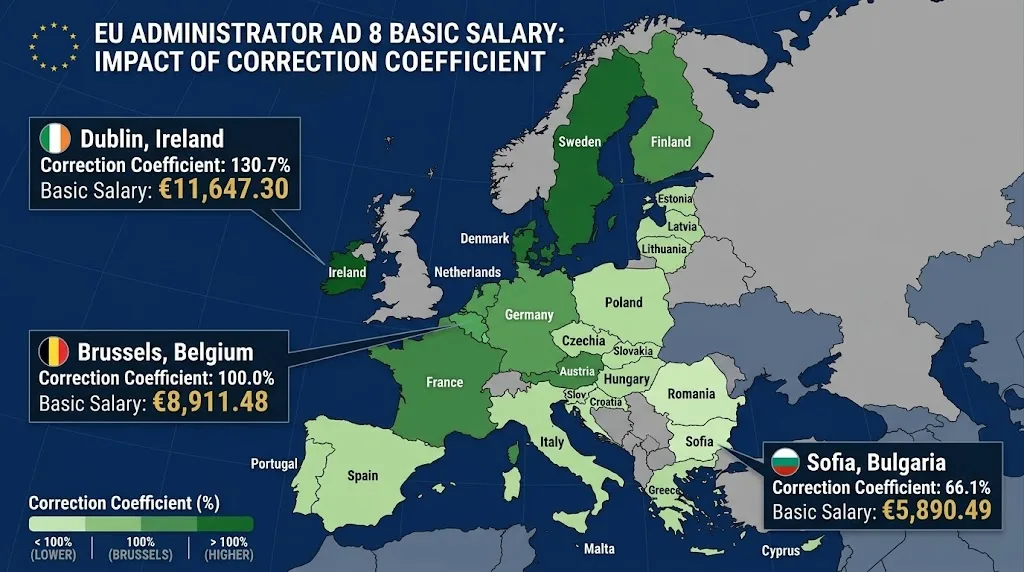
- Location Indexing: Outside Brussels and Luxembourg, your remuneration is weighted by local Correction Coefficients ranging from 66.1% in Sofia (€5,890.49 basic pay for AD 8 Step 1) to 130.7% in Dublin (€11,647.30).
Administrators in grade AD 8 are considered the initial senior (but lower management) roles across the European Commission, the European Parliament, the Council of the EU, and the other than 76 EU bodies and decentralised agencies.
Whether employed as permanent officials (fonctionnaires) or as Temporary Agents under Article 2(f) of the Conditions of Employment of Other Servants (CEOS), AD 8 staff routinely lead complex legislative dossiers, coordinate inter-institutional negotiations, or serve as team leaders and deputy heads of unit.
Your monthly take-home pay at grade AD 8 depends on three core variables:
- length of career in the EU institution,
- your family and residence status, and
- the city where your institution is headquartered.
Under Article 66 of the Staff Regulations, nominal basic monthly pay starts at €8,911.48 at AD 8 Step 1 and reaches €10,082.77 at Step 5. Eligible staff also receive national-tax-exempt allowances, including the 16% expatriation allowance for expats, household allowance, and dependent child allowances (€527.06 per child). The latter two are also available for staff of the country the institution is located in.
Basic salary vs. full remuneration package
A common misconception among candidates applying for senior EU posts is equating the published “basic monthly salary” with final net take-home pay. In the EU statutory system, basic salary serves purely as the calculation baseline before statutory additions and compulsory social and tax deductions are applied.
Official Salary Scale for Administrators AD 8
Under Article 66 of the Staff Regulations, basic monthly salaries are identical across all EU institutions and agencies prior to local weighting.
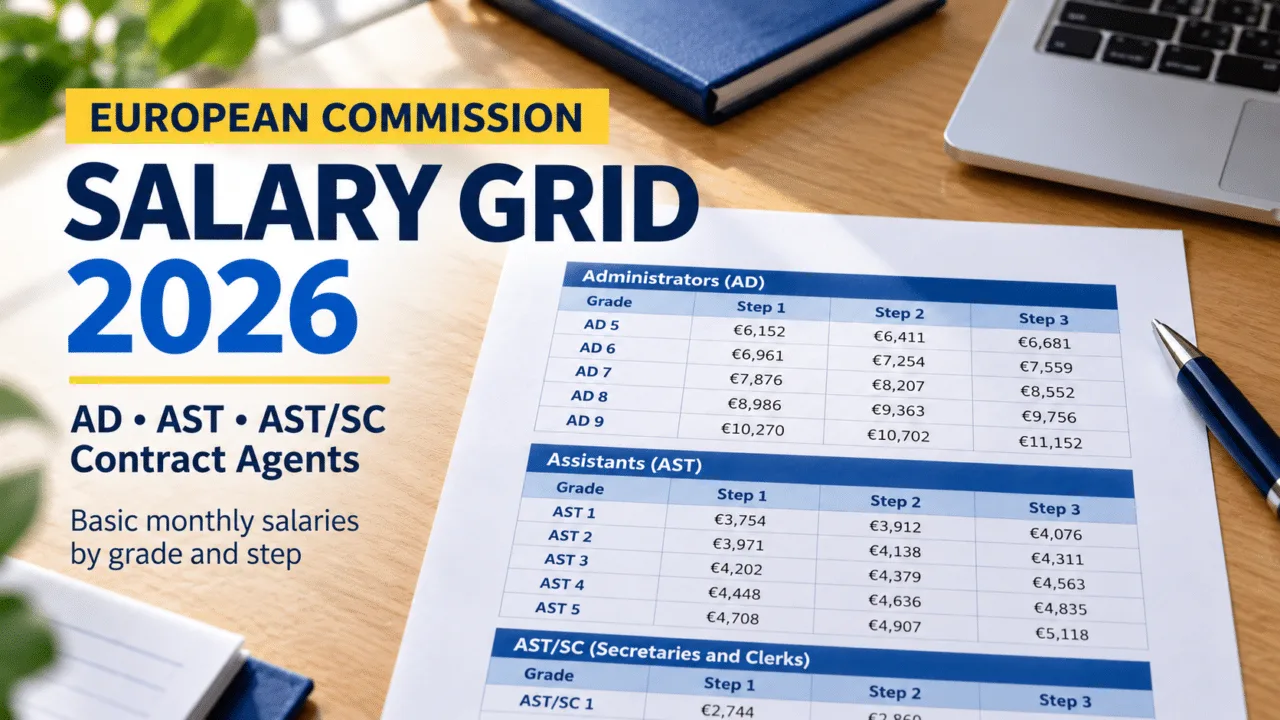
The table below sets out the official monthly basic gross salary scale for Administrator grades AD 6 through AD 10 across the five EU salary grid steps:
| Grade | Step 1 | Step 2 | Step 3 | Step 4 | Step 5 |
| AD 10 | €11,408.03 | €11,887.38 | €12,386.92 | €12,731.53 | €12,907.41 |
| AD 9 | €10,082.77 | €10,506.46 | €10,947.98 | €11,252.54 | €11,408.03 |
| AD 8 | €8,911.48 | €9,285.95 | €9,676.16 | €9,945.37 | €10,082.77 |
| AD 7 | €7,876.27 | €8,207.25 | €8,552.11 | €8,790.06 | €8,911.48 |
| AD 6 | €6,961.29 | €7,253.84 | €7,558.62 | €7,768.94 | €7,876.27 |
Source: Article 66 of the Staff Regulations
Correction coefficient and taxes
Depending on your family circumstances and whether you were recruited from abroad, your final net pay can range from roughly 72% to over 114% of your nominal basic salary. Furthermore, if your post is located outside Belgium or Luxembourg, your remuneration is multiplied by a local purchasing power index known as the Correction Coefficient.
Unlike national civil servants, EU officials are exempt from national income taxes on their institutional salaries. Instead, salaries are subject to an internal progressive EU Community Tax and a 6% Special Solidarity Levy deducted at source.

RELATED ARTICLES:
* Salary of Administrators AD5
* Salary of Administrators AD6
* Salary of Administrators AD7
* Salary of Administrators AD9
* Salary of Administrators AD10
* Salary of Administrators AD11
* Salary of Administrators AD12
* Salary of Administrators AD13
* Salary of Administrators AD14
* Salary of Administrators AD15
* Salary of Administrators AD16
Career Progression: How You Reach and Advance in Grade AD 8
Most permanent officials reach grade AD 8 via internal reclassification (promotion) after entering the EU civil service through an AD 5, AD 6, or AD 7 EPSO competition.
However, direct external recruitment at grade AD 8 also occurs regularly – particularly for Temporary Agent 2(f) posts at decentralised EU agencies and specialist EPSO competitions.
External candidates recruited directly at AD 8 are typically required to hold a university degree of at least four years (or three years plus one year of experience) alongside a minimum of 9 years of relevant post-graduate professional experience.
Once in grade AD 8, your salary progresses through two distinct statutory mechanisms:
- Automatic Step Advancement in the EU salary grid: Provided your annual performance appraisal is not unsatisfactory, you advance automatically by one step every two years. Moving from Step 1 (€8,911.48) to Step 2 (€9,285.95) after 24 months increases your gross base pay by €374.47 per month (or €4,493.64 per year) automatically.
- Reclassification (Promotion): Because each grade caps out at Step 5 (€10,082.77), advancing to AD 9 requires securing a promotion based on comparative merit during the annual appraisal exercise.
Administrators’ remuneration by family and residence status
BMost officials promoted or recruited into grade AD 8 start at Step 1, with a gross monthly basic salary of €8,911.48.
The table below provides an indicative breakdown of monthly net take-home pay in Brussels (Correction Coefficient 100.0%) across four typical personal and family situations:
| Situation 1: Single Local (No Children) | Situation 2: Married Local (2 Children) | Situation 3: Single Expat (No Children) | Situation 4: Married Expat (2 Children) | |
|---|---|---|---|---|
| Basic Salary (AD 8, Step 1) | €8,911.48 | €8,911.48 | €8,911.48 | €8,911.48 |
| Household Allowance (€241.21 + 2%) | €0.00 | €419.44 | €0.00 | €419.44 |
| Dependent Child Allowance (2 kids) | €0.00 | €1,054.12 | €0.00 | €1,054.12 |
| Expatriation Allowance (16%) | €0.00 | €0.00 | €1,425.84 | €1,661.61 |
| Pension Contribution (13.1%) | -€1,167.40 | -€1,167.40 | -€1,167.40 | -€1,167.40 |
| Sickness Insurance (JSIS, 1.7%) | -€151.50 | -€151.50 | -€151.50 | -€151.50 |
| Accident Insurance (0.1%) | -€8.91 | -€8.91 | -€8.91 | -€8.91 |
| EU Community Tax (Indicative) | -€985.00 | -€385.00 | -€985.00 | -€385.00 |
| Special Solidarity Levy (6%) | -€171.00 | -€171.00 | -€171.00 | -€171.00 |
| ESTIMATED NET TAKE-HOME PAY | €6,428 | €8,501 | €7,854 | €10,163 |
N.B. These calculations are only indicative as they are based on public sources. Only your institution’s HR department will be able to calculate a 100% accurate figure once you provide all necessary documents.
On top of the above, any children would either be guaranteed a place in the local European School, or an Education Allowance for each child.
Impact of Correction Coefficient on Administrators AD8 basic pay
To maintain equal purchasing power across all Member States under Article 64 of the Staff Regulations, Eurostat updates local Correction Coefficients every year. Brussels and Luxembourg serve as the baseline reference at 100.0%.
The table below shows how the nominal basic salary of an AD 8 Step 1 Administrator (€8,911.48) is adjusted across EU cities and agency locations:
| Duty Station / Country | Host EU Institution or Agency | Correction Coefficient | Adjusted AD 8 Step 1 Basic Pay |
|---|---|---|---|
| Dublin, Ireland | EUROFOUND | 130.7% | €11,647.30 |
| Copenhagen, Denmark | EEA | 130.5% | €11,629.48 |
| Stockholm, Sweden | ECDC | 119.5% | €10,649.22 |
| Paris / Lille / Valenciennes, France | EBA, ESMA, ERA | 113.6% | €10,123.44 |
| The Hague / Amsterdam, Netherlands | Eurojust, Europol, EMA | 113.2% | €10,087.80 |
| Munich, Germany | JRC / European Patent Office Liaison | 112.0% | €9,980.86 |
| Helsinki, Finland | ECHA | 110.8% | €9,873.92 |
| Vienna, Austria | FRA | 106.7% | €9,508.55 |
| Berlin / Frankfurt / Cologne / Karlsruhe, Germany | ECB, EIOPA, AMLA, EASA, JRC | 102.7% | €9,152.09 |
| Brussels, Belgium | European Commission, EP, Council, EDA, SRB | 100.0% | €8,911.48 |
| Luxembourg City, Luxembourg | CJEU, ECA, Eurostat, CdT, EPPO | 100.0% | €8,911.48 |
| Tallinn, Estonia | eu-LISA | 95.0% | €8,465.91 |
| Madrid / Alicante / Bilbao / Vigo / Barcelona, Spain | EUIPO, EU-OSHA, EFCA, F4E | 92.4% | €8,234.21 |
| Lisbon, Portugal | EMSA, EUDA (EMCDDA) | 92.4% | €8,234.21 |
| Valletta, Malta | EUAA | 92.4% | €8,234.21 |
| Prague, Czechia | EUSPA | 91.2% | €8,127.27 |
| Rome / Parma / Turin / Ispra, Italy | EFSA, ETF, JRC | 87.5% | €7,797.55 |
| Vilnius, Lithuania | EIGE | 87.4% | €7,788.63 |
| Athens / Heraklion / Thessaloniki, Greece | ENISA, CEDEFOP | 87.0% | €7,752.99 |
| Ljubljana, Slovenia | ACER | 86.6% | €7,717.34 |
| Bratislava, Slovakia | ELA | 85.1% | €7,583.67 |
| Riga, Latvia | BEREC | 84.3% | €7,512.38 |
| Zagreb, Croatia | EU Representation | 84.3% | €7,512.38 |
| Warsaw, Poland | Frontex | 82.3% | €7,334.15 |
| Nicosia, Cyprus | EU Representation | 79.0% | €7,040.07 |
| Budapest, Hungary | CEPOL, EIT | 76.6% | €6,826.19 |
| Bucharest, Romania | ECCC, EU Representation | 72.9% | €6,496.47 |
| Sofia, Bulgaria | EU Representation | 66.1% | €5,890.49 |
Sources
This article is based on the European Commission Staff Regulations and other publicly available information such as EU institutions’ vacancy announcements. As the EU legal documents and even information on the various websites is hard to understand, this article is one from a series that tries to make information about employment in the European Commission and other EU institutions more accessible.
I wrote this article to make it easier to understand the sometimes complex EU HR and administrative rules. However, your individual case might have unique angles due to prior work experience, family situation, or other factors.
Where to ask questions?
Rather than leaving a comment below, please bring your questions to our Jobs in EU Institutions Facebook Group. We have nearly 10,000 members there, including EU ‘insiders’, so you will receive a much faster and more thorough reply from me and the community.
Looking for weekly ‘Zero EPSO’ vacancies across EU institutions and daily tips?
Follow the Jobs in EU Institutions Facebook Page and join alongside over 6,000 other followers.Best regards, Ben
 Best regards, Ben