
Last checked for accuracy on 21 October 2026.
This article shows how much Administrators in grade AD7 step 1 can expect to earn in the European Commission. The information directly applies also to the European Parliament, the Council of the European Union, EU agencies and all other EU institutions. The article presents the full remuneration package: not only the basic salary, but also allowances and other benefits. It also shows the impact of location and the Correction Coefficient on your take-home pay.
Basic salary vs. full remuneration package
The monthly ‘basic salary’ for Administrators AD7 in the European Commission and other EU institutions ranges from EUR EUR 7 876,27 to 8 911,48. The starting basic salary will always be the lower number, but will advance a step in the salary grid every 2 years. Also – you can get ‘reclassified’ to a higher grade (AD8 and higher) based on good performance.
‘Reclassification‘ is the promotion of EU institutions’ staff based on good professional performance. In the EU civil service, reclassification means advancing to the next higher grade (AD 8) following the annual appraisal process. Promotion has the most significant impact on your income, unless you succeed in a selection process for a position with an even higher grade.
At the same time, knowing your ‘basic salary’ in most cases does not tell you much about your final take-home pay. There are two reasons for this.
Firstly, the basic salary is supplemented by a number of allowances. This is especially so if you have children, a spouse or/and are an expat.
Secondly, the country you are employed in has a significant impact on your total salary due to the ‘Correction Coefficient‘. Brussels is used as reference and there the Correction Coefficient is 100% of basic salary as quoted below. If you work for an EU agency in Scandinavia, your salary and allowances will upped by additional 18-31% to compensate for higher living costs. Conversely, if you will work for the EU in Bulgaria, you will get only around 65% of what your Brussels colleague doing the same job gets.
Administrators’ remuneration by family and residence status
Below is a sample salary and take-home pay approximation of an Administrator in grade AD7 step 1 who is living in Brussels, Belgium, with four typical personal/family situations.
| Situation 1 | Situation 2 | Situation 3 | Situation 4 |
|---|---|---|---|
| Single local with no children | Married local with two children | Single expat with no children | Married expat with two children |
| Administrators AD7 salary EUR |  |  |  |  |
|---|---|---|---|---|
| Basic Pay | 7867 | 7867 | 7867 | 7867 |
| Household allowance | 0 | 399 | 0 | 399 |
| Dependent child allowance | 0 | 1054 | 0 | 1054 |
| Expatriation allowance | 0 | 0 | 1260 | 1493 |
| Pension contribution (12.10%) | -953 | -953 | -953 | -953 |
| Health insurance contribution (JSIS coverage) | -134 | -134 | -134 | -134 |
| Accident insurance contribution | -8 | -8 | -8 | -8 |
| Tax | -678 | -330 | -835 | -440 |
| Special levy (6%) | -155 | -155 | -210 | -215 |
| Correction coefficient | 100% | 100% | 100% | 100% |
| TOTAL REMUNERATION if employed in Brussels | 5948 | 7749 | 6996 | 9072 |
N.B. These calculations are only indicative as they are based on public sources. Only your institution’s HR department will be able to calculate a 100% accurate figure once you provide all necessary documents.
On top of the above, any children would either be guaranteed a place in the local European School, or an Education Allowance for each child. The expat family would also get an annual Travel Grant per family member depending on the distance from home country to place of employment.
RELATED ARTICLES:
* Salary of Administrators AD5
* Salary of Administrators AD6
* Salary of Administrators AD8
* Salary of Administrators AD9
* Salary of Administrators AD10
* Salary of Administrators AD11
* Salary of Administrators AD12
* Salary of Administrators AD13
* Salary of Administrators AD14
* Salary of Administrators AD15
* Salary of Administrators AD16
European Commission salary scale for Administrators AD7
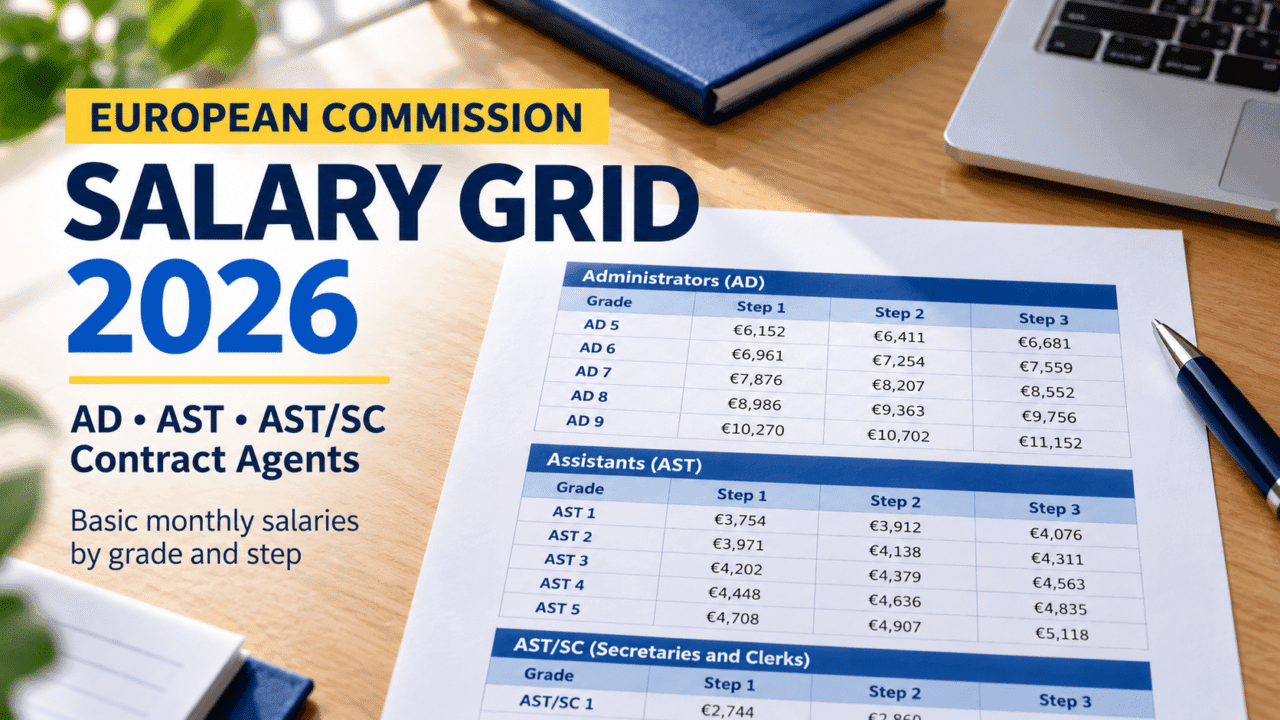
| Grade | Step 1 | Step 2 | Step 3 | Step 4 | Step 5 |
| AD 8 | 8 911,48 | 9 285,95 | 9 676,16 | 9 945,37 | 10 082,77 |
| AD 7 | 7 876,27 | 8 207,25 | 8 552,11 | 8 790,06 | 8 911,48 |
| AD 6 | 6 961,29 | 7 253,84 | 7 558,62 | 7 768,94 | 7 876,27 |
Impact of Correction Coefficient on AD7 Basic Pay
The below tables show you the actual Administrators AD7 step 1 basic pay according to the correction coefficient by location of your institution. You should also read a dedicated article about the Correction Coefficient to understand the details.
Take into account that your allowances will also be adjusted by the Correction Coefficient. If you will work not in Brussels, but in another EU location, you should multiply the grand total values in the “scenarios table” to get the actual approximate figure.
Alphabetical order
| Country | Correction Coefficient (%) | AD7 Step 1 Basic Salary (EUR) |
| Austria | 105.4 | 8 301.59 |
| Belgium | 100.0 | 7 876.27 |
| Bulgaria | 64.8 | 5 103.82 |
| Croatia | 82.3 | 6 482.17 |
| Cyprus | 79.4 | 6 253.76 |
| Czechia | 91.8 | 7 230.42 |
| Denmark | 129.8 | 10 223.40 |
| Estonia | 93.4 | 7 356.44 |
| Finland | 112.0 | 8 821.42 |
| France | 114.2 | 8 994.70 |
| Germany | 102.2 | 8 049.55 |
| Greece | 86.0 | 6 773.59 |
| Hungary | 75.5 | 5 946.58 |
| Ireland | 130.7 | 10 293.79 |
| Italy | 87.6 | 6 899.61 |
| Latvia | 84.1 | 6 623.94 |
| Lithuania | 86.7 | 6 828.73 |
| Luxembourg | 100.0 | 7 876.27 |
| Malta | 91.8 | 7 230.42 |
| Netherlands | 111.4 | 8 774.16 |
| Poland | 78.8 | 6 206.50 |
| Portugal | 92.1 | 7 254.04 |
| Romania | 72.1 | 5 678.79 |
| Slovakia | 84.2 | 6 631.82 |
| Slovenia | 85.9 | 6 765.72 |
| Spain | 92.3 | 7 269.80 |
| Sweden | 117.7 | 9 270.37 |
By value – highest to lowest Correction Coefficient
| Country | Correction Coefficient (%) | AD7 Step 1 Basic Salary (EUR) |
| Ireland | 130.7 | 10 293.79 |
| Denmark | 129.8 | 10 223.40 |
| Sweden | 117.7 | 9 270.37 |
| France | 114.2 | 8 994.70 |
| Finland | 112.0 | 8 821.42 |
| Netherlands | 111.4 | 8 774.16 |
| Austria | 105.4 | 8 301.59 |
| Germany | 102.2 | 8 049.55 |
| Belgium | 100.0 | 7 876.27 |
| Luxembourg | 100.0 | 7 876.27 |
| Estonia | 93.4 | 7 356.44 |
| Spain | 92.3 | 7 269.80 |
| Portugal | 92.1 | 7 254.04 |
| Malta | 91.8 | 7 230.42 |
| Czechia | 91.8 | 7 230.42 |
| Italy | 87.6 | 6 899.61 |
| Lithuania | 86.7 | 6 828.73 |
| Greece | 86.0 | 6 773.59 |
| Slovenia | 85.9 | 6 765.72 |
| Slovakia | 84.2 | 6 631.82 |
| Latvia | 84.1 | 6 623.94 |
| Croatia | 82.3 | 6 482.17 |
| Cyprus | 79.4 | 6 253.76 |
| Poland | 78.8 | 6 206.50 |
| Hungary | 75.5 | 5 946.58 |
| Romania | 72.1 | 5 678.79 |
| Bulgaria | 64.8 | 5 103.82 |
Allowances and other benefits for EU institutions staff
Several allowances and other benefits can quite significantly boost an EU official’s income. This largely depends on whether the person is an expat and has a spouse and/or children. When considering a job at an EU institution, people too often do not take these benefits into account. Important – these benefits are available to Administrators in grades AD 5-16, Assistants in grades AST 1-11, Secretaries and Clerks in grades AST/SC 1-6, and Contract Agents in grades FG I-IV.
- Travel costs on taking up duties. Reimbursement of travel costs for the official and eligible family members from the place of recruitment to the place of employment.
- Daily subsistence allowance. Paid during your initial onboarding period if you must change your residence to take up duties at your place of employment. Staff entitled to the household allowance (staff with a spouse or/and dependents) receive €55.40 per calendar day for up to 10 months (probation period plus one month). Staff without household allowance receive €44.68 per calendar day for 120 days.
- Installation allowance and coverage of removal costs (one-time payments). A lump sum granted upon completing your probationary period when moving your domicile. Single staff receive one month’s basic salary (with a statutory floor of €1,577.18 for officials and temporary agents, and €937.77 for contract agents). Staff relocating with family receive two months’ basic salary (minimum €1,577.18).
- Expatriation allowance or Foreign Residence allowance. Paid to officials who are not nationals of their host country and have not habitually resided or carried out their main occupation there during the five years ending six months before entering the service. It equals 16% of the sum of basic salary, household allowance, and dependent child allowances (subject to a statutory minimum of €714.89 per month). Expats who are not entitled to the expatriation allowance get a foreign residence allowance that equals 4% of the basic salary amount (subject to a statutory minimum of €178.65 per month).
- Household allowance. Calculated as a flat base of €241.21 plus 2% of basic salary for married staff, registered non-marital partners, or single parents with dependent children.
- Dependent child allowance. A flat payment of €527.06 per month per child, granted automatically up to age 18, or up to age 26 while the child is in full-time educational or vocational training.
- European School enrollment for children or Education allowance. Children of EU institutions staff enjoy free tuition at local European Schools. Where no European School is available and university attendance, staff receive a statutory Education Allowance or a Pre-school Allowance. The Education Allowance amount is up to a ceiling of €357.62, and is doubled if there is no European School near the institution’s headquarters. The Pre-school Allowance amount is €128.76 per month. Both allowances are subject to the correction coefficient.
- Healthcare costs reimbursement to a level of 80-85% through the EU’s Joint Sickness Insurance Scheme (JSIS) for the employee and any direct family members and dependents. 100% reimbursement of costs in case of a serious illness.
- Accident insurance.
- Annual travel grant. An annual flat-rate payment assisting expatriate staff and family members with travel to their official place of origin.
- Birth & adoption grant. A flat-rate grant of €198.31 paid upon the birth or adoption of a child.
- Parental leave allowance. Statutory leave grant of €1,289.65 per month (or €1,719.56 per month for single parents) during approved parental leave.
- Unemployment allowance.
- Removal expenses when leaving your home country and again when leaving your EU institution.
- EU pension, survivors and orphan’s pensions, invalidity allowance.
- Lump sum payments in case of permanent invalidity or death.
- Lump sum funeral expenses. Costs incurred upon the death of an official, their spouse, or dependent child are reimbursed up to a statutory ceiling of €3,365.18. If death occurs while on official mission, the costs of repatriating the body to the official’s place of origin are fully covered by the institution.
- Invalidity & Survivor Pensions: Comprehensive life, disability, and death social security/coverage. In case of accidental death related to duties, a lump sum of 5 times the annual basic salary is paid to eligible beneficiaries, with invalidity and orphan pensions ensuring partial income continuation.
Sources
This article is based on the European Commission Staff Regulations and other publicly available information such as EU institutions’ vacancy announcements. As the EU legal documents and even information on the various websites are hard to understand, this article is one from a series that tries to make information about employment in the European Commission and other EU institutions more accessible.
I wrote this article to make it easier to understand the sometimes complex EU HR and administrative rules. However, your individual case might have unique angles due to prior work experience, family situation, or other factors.
Where to ask questions?
Rather than leaving a comment below, please bring your questions to our Jobs in EU Institutions Facebook Group. We have nearly 10,000 members there, including EU ‘insiders’, so you will receive a much faster and more thorough reply from me and the community.
Looking for weekly ‘Zero EPSO’ vacancies across EU institutions and daily tips?
Follow the Jobs in EU Institutions Facebook Page and join alongside over 6,000 other followers.Best regards, Ben
 Best regards, Ben



11 responses to “What is the salary of Administrators AD 7?”
It would be nice to have all the data updated; in particular the basic monthly salaries for each grade and step in function groups AD and AST applicable from 1 July 2023.
Fair point. While I get around to that, you can check the current basic salaries in this article: https://euemployment.eu/european-commission-salary-grid/
Can citizens of non-EU states apply for jobs in EU institutions? If so, what caveats and restrictions apply? Thank you.
Hi! In general, no. However, some SNE positions are availabe to EU candidate countries, e.g., Western Balkans. There are also some EU agencies where non-EU states like Norway contribute funding. I believe that in these cases the nationals of the respective countries have some employment opportunities, but I haven’t looked in detail into this.
I was offered a contract as temporary agent AD7 step2. From what I understand the tax deduction is levied progressively at a rate of between 8% to
45 % of the taxable portion of the salary. Would somebody know what rate applies to AD7, is it 8% or more? Many thanks.
Hi! I cannot tell you the exact tax rate, but it will be closer to 8% rather than 45%. The higher rates almost exclusively apply to the top positions like AD14-16. See article 4 of this regulation. You might be able to calculate the applicable rate based on the information provided there.
Tax (tax, Special levy, …) is already mentioned in the overview -> is the final number 5219 (single person from belgium) still taxable in home country?
What other post should be deducted from the final number?
Salaries in EU institutions are not taxed on the national level.
Indeed, the calculation (at least for scenario 3) is wrong, it is around 5500 € not 6200 €
This calculation in at least scenario 3 is wrong! The result is 5871 not 6186 euros!
Hi there,
Why do the taxes go down where there is a child allowance?
Many thanks,
John