

Last reviewed for accuracy on 3 November 2026.
Employees of the European Commission, the European Parliament, the Council of the European Union, EU agencies, and other EU bodies who raise children receive dedicated financial support through the EU education allowance and preschool allowance.
Depending on your child’s age and your place of employment, these allowances help cover early childhood costs, primary and secondary school tuition, school transport, and university studies up to age 26.
This guide explains the current rates of these education allowances, eligibility rules, correction coefficient impact, and administrative procedures in accordance with the EU Staff Regulations, the Conditions of Employment of Other Servants, and the remuneration and correction coefficient updates in force since 2026.
Key Takeaways
- Broad Staff Eligibility: EU institutions staff who receive the Dependent Child Allowance qualify for educational support for each child until age 18, and up to age 26 if studies are continued.
- Three Stages of Support: You receive a fixed monthly Preschool Allowance (EUR 128.76) before primary school, a Primary and Secondary Education Allowance reimbursing actual tuition and transport fees (up to EUR 357.62 per month), and an automatic flat-rate Higher Education Allowance (EUR 357.62 per month) during university studies.
- When the Allowance Doubles: The monthly education allowance ceiling doubles to EUR 715.24 if your place of employment is at least 50 km from a European School, if the local European School cannot admit your child for valid educational reasons, or if your child attends a university at least 50 km away.
- Cost-of-Living Indexation: All allowance amounts are multiplied by the Correction Coefficient of your place of employment.
- Additional Support in EU Agencies and Delegations: Many EU agencies in cities without a European School—as well as EU Delegations outside the European Union—cover higher international school tuition directly or apply higher reimbursement ceilings.
Table of Contents
- Who Is Eligible for the Education Allowance?
- Overview of the Three Allowance Stages and Current Amounts
- Preschool Allowance (Early Childhood and Kindergarten)
- Primary and Secondary Education Allowance
- Higher Education Allowance (University and Vocational Studies)
- When Is the Education Allowance Doubled?
- Preschool and Education Allowance by City and EU Institution (2026 Table)
- Reimbursement of School Transport Expenses
- Duration of Payments and Working Students (Ages 18 to 26)
- Special Family Situations, Disability Support, and National Grants
- How to Apply and Payslip Codes
- Sources

1. Who Is Eligible for the Education Allowance?
To qualify for the preschool allowance or the education allowance, you must meet two cumulative conditions:
- Eligible Staff Categories: You must be employed as a Permanent Official, a Temporary Agent, or a Contract Agent. See our guide to staff categories in EU institutions for a full explanation of these roles. Seconded National Experts (SNEs), interim staff, and trainees are governed by separate rules and do not receive family allowances under the Staff Regulations. Likewise, the European Investment Bank (EIB) and the European Central Bank (ECB) maintain independent staff regulations and benefit structures.
- Dependent Child Status: You must receive the Dependent Child Allowance for the child concerned. Under the Staff Regulations, a dependent child is a legitimate, natural, or adopted child of the staff member or their spouse who is actually maintained by the staff member.

2. Overview of the Three Allowance Stages and Current Amounts
Educational support under the EU Staff Regulations evolves across three stages as your child grows. All baseline figures below apply to Brussels and Luxembourg (where the Correction Coefficient is 100%) and are adjusted by the local Correction Coefficient at your place of employment:
| Allowance Stage | Payslip Code | Child’s Age & Educational Level | How It Is Calculated & Paid | Monthly Base (100% CC) | Monthly Double Ceiling (100% CC) |
| Preschool Allowance | AEN / APS | Under age 5, or aged 5 to 8 and not yet in full-time attendance at a primary school. | Flat-rate lump sum paid automatically every month; no invoices required. | EUR 128.76 | Not applicable |
| Primary & Secondary Education Allowance | ISN | Aged at least 5 and attending a fee-charging primary or secondary school full-time (or any school for transport). | Reimbursement of actual costs (1/12th of annual tuition, registration, and transport fees, up to the ceiling). | Up to EUR 357.62 | Up to EUR 715.24 |
| Higher Education Allowance | ISF | Up to age 26 and attending a university or higher education institution full-time. | Flat-rate lump sum paid automatically upon enrollment proof; no tuition or rent invoices required. | EUR 357.62 | EUR 715.24 |

3. Preschool Allowance (Early Childhood and Kindergarten)
For every dependent child who is younger than 5 years old—or who is aged 5 or older but has not yet started full-time primary school—you receive a fixed Preschool Allowance of EUR 128.76 per month, weighted by the Correction Coefficient of your place of employment.
- Automatic Payment Without Invoices: Because the Preschool Allowance is a flat-rate benefit, the Paymaster Office (PMO) pays it automatically once your child is registered as a dependent child. You receive the full amount whether your child attends a private nursery, goes to a free public kindergarten, or stays at home.
- Upper Age Limit: Entitlement to the Preschool Allowance stops on the first day of the month in which your child begins primary school, or at the latest at the end of the month in which the child reaches age 8.
- Why the Preschool Allowance Is Lower—and How EU Agencies Bridge the Gap: Expatriate parents are often surprised that the Preschool Allowance is less than half the school-age ceiling. Historically, the allowance was designed around the Belgian and French public childcare systems, where subsidised municipal crèches and early école maternelle classes are widely available from a young age. In many other EU Member States, private kindergartens cost as much as private primary schools. To address this gap, several decentralised EU agencies have introduced internal social welfare measures that equalize preschool and school-age allowances or reimburse nursery fees directly. If your institution does not yet have a preschool top-up policy, you can request case-by-case support from your Executive Director or propose a formal staff request through your Staff Committee.
4. Primary and Secondary Education Allowance
Entitlement to the Primary and Secondary Education Allowance starts on the first day of the month in which a child aged at least 5 begins regular, full-time attendance at a primary school. Unlike the preschool and university stages, the allowance during primary and secondary school operates strictly as a reimbursement of actual eligible costs incurred, up to a monthly ceiling of EUR 357.62 (single rate) or EUR 715.24 (double rate), adjusted by your local Correction Coefficient.
4.1. Eligible vs. Excluded Schooling Costs
Only compulsory fees required for admission, tuition, and daily school transport can be reimbursed under the primary and secondary ceiling:
- Covered Costs (up to the monthly ceiling):
- Compulsory tuition and attendance fees at a fee-charging primary or secondary school.
- Compulsory registration, admission, and annual re-enrollment fees.
- School transport expenses (reimbursed even if the school itself is free of tuition, such as a European School or a state public school).
- Excluded Costs:
- School canteen meals and snacks.
- School uniforms and sports attire.
- Textbooks, stationery, digital devices, and learning materials.
- Extracurricular activities, sports/music clubs, optional school trips, and after-school care (garderie).
4.2. Total Amount of Reimbursed Education Costs
To simplify monthly budgeting, the PMO does not reimburse school fees based on when an invoice arrives; instead, it applies an annualized calculation framework. Understanding how the PMO processes these figures ensures that your claims are approved without administrative delays.
When you submit your child’s schooling documents, the PMO calculates your monthly payout by combining all eligible annual registration, tuition, and transport fees for the entire academic year and dividing that total by 12, capped at your monthly ceiling (EUR 357.62 or EUR 715.24, multiplied by your local Correction Coefficient). Because schooling costs are spread evenly across all 12 months, the frequency of your school’s billing—whether you pay in a single annual lump sum, three termly payments, or ten or twelve monthly installments—has no impact on your total annual reimbursement.
To ensure your claim is processed smoothly by PMO, always request itemized contracts and invoices from your child’s school. When enrolling your child in a fee-charging private or international school, make sure the billing documents list compulsory tuition and registration fees on separate lines, cleanly isolated from non-eligible items such as canteen meals, textbooks, uniforms, or after-school care (garderie).
If a school issues an unitemized “all-inclusive” invoice, the PMO cannot verify the eligible portion, which may result in standard flat deductions or a suspension of payments until you provide an itemized breakdown signed by the school administration.
If a primary or secondary pupil attends a school that does not charge tuition fees but lives away from the family home in paid accommodation (such as a boarding school), the allowance can be claimed to cover accommodation costs upon presentation of a formal contract and payment receipts.
4.3. Direct School Fee Coverage in EU Agencies and EU Delegations
In cities served by a European School or an Accredited European School, children of EU staff (Category I pupils) attend free of tuition fees. If you work in Brussels or Luxembourg and choose to send your child to a private international school instead of a European School, you will receive only the single Education Allowance (up to EUR 357.62 per month) and must cover the remaining tuition from your own pocket.
Outside Brussels and Luxembourg, two special frameworks provide substantially higher coverage:
- Decentralised EU Agencies Without a European School: Many EU agencies located in cities without a European School (or where the local Accredited European School does not offer all grade levels) have signed seat agreements with the host country or direct service contracts with local international schools. For instance, the EU Agency for Fundamental Rights (FRA) in Vienna pays tuition fees directly to partner international schools in the Vienna area. Under such arrangements, the agency covers tuition costs that significantly exceed the standard Staff Regulations ceiling.
- Staff Posted to EU Delegations Outside the EU: Officials and agents serving in EU Delegations in third countries are covered by Annex X to the Staff Regulations, which reimburses actual primary and secondary schooling costs upon presentation of supporting documents up to a standard ceiling of three times the doubled maximum education allowance (EUR 2,145.72 per month per child from 1 July 2025). Where local international schooling costs exceed even that ceiling, the appointing authority may authorise higher reimbursement in exceptional cases.

5. Higher Education Allowance (University and Vocational Studies)
When your child completes secondary school and enrolls full-time at a university, college, or higher vocational institute, the allowance changes from a cost-reimbursement scheme into an automatic flat-rate monthly payment:
- No Tuition or Rent Invoices Required: You receive the full flat-rate Higher Education Allowance of EUR 357.62 per month (or EUR 715.24 per month if doubled), adjusted by the Correction Coefficient of your place of employment. You receive this lump sum even if the university charges zero tuition fees, and you do not need to submit rent contracts, boarding receipts, or transport bills.
- Minimum Programme Workload and Duration: Short training courses do not qualify as higher education. The academic or vocational programme must consist of at least 16 hours of instruction per week for a minimum of 3 consecutive months.
- Distance Learning: Remote or online university degrees are reviewed individually by the PMO. You should expect to provide official university certificates confirming full-time enrollment, weekly study hours, and active participation in examinations.
- Universities Outside the EU and International Mobility (Erasmus): The flat-rate Higher Education Allowance is paid regardless of whether the university is located in an EU Member State or in a non-EU country (such as the United Kingdom, Switzerland, the United States, or Canada). Likewise, if a student enrolled at an EU university spends a semester or year abroad through Erasmus or an international exchange programme, entitlement continues without interruption.

6. When Is the Education Allowance Doubled?
The monthly ceiling doubles from EUR 357.62 to EUR 715.24 (before applying your local Correction Coefficient) under specific geographic or educational conditions:
- During Primary and Secondary School:
- Your official place of employment is located at least 50 km from the nearest European School (or Accredited European School). This automatically entitles staff at EU agencies and offices in cities without a European School to the double ceiling against actual schooling costs.
- There is a European School within 50 km of your place of employment, but your child cannot attend it for imperative educational reasons supported by formal proof. Valid reasons include: the local European School does not offer the specific grade/year your child requires, lacks a language section corresponding to your child’s schooling language, refuses admission due to lack of capacity, or cannot accommodate a child’s documented disability or special educational needs.
- During Higher Education:
- Your child attends a university or higher education institution located at least 50 km from your place of employment.
6.1. What If Your Children Remain in Your Home Country?
For primary and secondary schooling, entitlement to the double ceiling is assessed based on your official place of employment (the duty station written in your contract where you are expected to work), not where your family lives:
- Primary and Secondary Pupils Staying Behind: If your place of employment is Brussels, Luxembourg, or another city with a European School that has a place available for your child, and your children remain in your home country where there is no European School, you will receive only the single Education Allowance (up to EUR 357.62 against actual school fees). The same rule applies if you telework from your home country while assigned to a place of employment that has a European School. Because your children would have been guaranteed a place in the European School had they relocated with you to your duty station, you cannot claim the double ceiling.
- University Students Studying in Your Home Country: Conversely, if your child attends a university in your home country (or any other country) located at least 50 km away from your place of employment, you do qualify for the double flat-rate Higher Education Allowance (EUR 715.24 per month, weighted by the Correction Coefficient of your place of employment).

7. Preschool and Education Allowance by City and EU Institution
Both the Preschool Allowance and the Education Allowance are adjusted by the Correction Coefficient at your place of employment. The table below lists EU duty stations alphabetically by city, the institutions or agencies located there, the current Correction Coefficient, the monthly Preschool Allowance, and the monthly Single Education Allowance in euros.
If you qualify for the Double Education Allowance, simply multiply the final column by two (for example, EUR 715.24 in Brussels and Luxembourg):
| City / Duty Station | EU Institution / Agency | CC (%) | Preschool Allowance (€) | Education Allowance (€) |
| Alicante, Spain | EUIPO | 92.4 | 118.97 | 330.44 |
| Amsterdam, Netherlands | EMA | 113.2 | 145.76 | 404.83 |
| Angers, France | CPVO | 113.6 | 146.27 | 406.26 |
| Athens, Greece | ENISA Office, EU Representation | 87.0 | 112.02 | 311.13 |
| Barcelona, Spain | F4E | 92.4 | 118.97 | 330.44 |
| Berlin, Germany | EU Representation | 102.7 | 132.24 | 367.28 |
| Bilbao, Spain | EU-OSHA | 92.4 | 118.97 | 330.44 |
| Bonn, Germany | EU Representation | 102.7 | 132.24 | 367.28 |
| Bratislava, Slovakia | ELA | 85.1 | 109.57 | 304.33 |
| Brussels, Belgium | European Commission, European Parliament, Council of the EU, EEAS, EDA, SRB, EESC, CoR | 100.0 | 128.76 | 357.62 |
| Bucharest, Romania* | ECCC | 77.5 | 99.79 | 277.16 |
| Budapest, Hungary | CEPOL, EIT | 76.6 | 98.63 | 273.94 |
| Cologne, Germany | EASA | 102.7 | 132.24 | 367.28 |
| Copenhagen, Denmark | EEA | 130.5 | 168.03 | 466.69 |
| Dublin, Ireland | Eurofound | 130.7 | 168.29 | 467.41 |
| Frankfurt am Main, Germany | AMLA, EIOPA | 102.7 | 132.24 | 367.28 |
| Hague (The Hague), Netherlands | Europol, Eurojust | 113.2 | 145.76 | 404.83 |
| Helsinki, Finland | ECHA | 110.8 | 142.67 | 396.24 |
| Heraklion, Greece | ENISA | 87.0 | 112.02 | 311.13 |
| Karlsruhe, Germany | JRC | 102.7 | 132.24 | 367.28 |
| Lefkosia (Nicosia), Cyprus | EU Representation | 79.0 | 101.72 | 282.52 |
| Lille / Valenciennes, France | ERA | 113.6 | 146.27 | 406.26 |
| Lisbon, Portugal | EMSA, EUDA (EMCDDA) | 92.4 | 118.97 | 330.44 |
| Ljubljana, Slovenia | ACER | 86.6 | 111.51 | 309.70 |
| Luxembourg City, Luxembourg | European Commission, Eurostat, CJEU, Court of Auditors, EPPO, CdT | 100.0 | 128.76 | 357.62 |
| Madrid, Spain | EU Representation | 92.4 | 118.97 | 330.44 |
| Munich, Germany | EU Representation (Munich rate) | 112.0 | 144.21 | 400.53 |
| Paris, France | EBA, ESMA | 113.6 | 146.27 | 406.26 |
| Parma, Italy | EFSA | 87.5 | 112.67 | 312.92 |
| Prague, Czechia | EUSPA | 91.2 | 117.43 | 326.15 |
| Riga, Latvia | BEREC Office | 84.3 | 108.54 | 301.47 |
| Rome, Italy | EU Representation | 87.5 | 112.67 | 312.92 |
| Seville, Spain | JRC | 92.4 | 118.97 | 330.44 |
| Sofia, Bulgaria | EU Representation | 66.1 | 85.11 | 236.39 |
| Stockholm, Sweden | ECDC | 119.5 | 153.87 | 427.36 |
| Strasbourg, France | European Parliament, Ombudsman, eu-LISA | 113.6 | 146.27 | 406.26 |
| Tallinn, Estonia | eu-LISA | 95.0 | 122.32 | 339.74 |
| Thessaloniki, Greece | CEDEFOP | 87.0 | 112.02 | 311.13 |
| Turin, Italy | ETF | 87.5 | 112.67 | 312.92 |
| Valletta, Malta | EUAA | 92.4 | 118.97 | 330.44 |
| Varese / Ispra, Italy | JRC | 87.0 | 112.02 | 311.13 |
| Vienna, Austria | FRA | 106.7 | 137.39 | 381.58 |
| Vigo, Spain | EFCA | 92.4 | 118.97 | 330.44 |
| Vilnius, Lithuania | EIGE | 87.4 | 112.54 | 312.56 |
| Warsaw, Poland | Frontex | 82.3 | 105.97 | 294.32 |
| Zagreb, Croatia | EU Representation | 91.3 | 117.56 | 326.51 |

8. Reimbursement of School Transport Expenses
All dependent children of EU staff attending primary or secondary school are eligible for reimbursement of school commuting costs, irrespective of whether they attend a European School, a fee-charging private school, or a free public school. Transport expenses are reimbursed as part of the Primary and Secondary Education Allowance (ISN) and do not increase the overall monthly limit (EUR 357.62 single / EUR 715.24 double).
The PMO recognises four modes of school transport, each with its own reimbursement procedure:
| Transport Mode | How Reimbursement Works | Required Documentation |
| European School Bus | Paid directly by the PMO to the European School parents’ association or transport office once your entitlement is confirmed. | Confirmation of European School enrollment and bus registration in Sysper. |
| Other School Bus Services | Reimbursed to the staff member as part of the monthly Primary and Secondary Education Allowance (1/12th of annual cost). | School transport contract or invoice and proof of payment. |
| Public Transport | Reimbursed to the staff member based on the price of the child’s seasonal or annual public transit pass. | Copy of the seasonal/annual public transport ticket and receipt of payment. |
| Private Car | Reimbursed only where public or school transport is unavailable or impractical, capped at the price of an equivalent seasonal/annual public transport pass. | Written justification and reference pricing from the local public transport authority for the school year. |

9. Duration of Payments for Working Students (Ages 18 to 26)
9.1. Age 26 Limit, Interrupted Studies, and Military Service
The Education Allowance supports your child’s education throughout their bachelor’s, master’s, or doctoral degrees until they complete their studies or turn 26 years old. Specifically, payment ceases at the end of the month in which the child finishes their education or at the end of the month in which the child reaches age 26, whichever comes first.
Two specific situations frequently arise for older students:
- Extension for Compulsory Military Service: The only circumstance in which the Education Allowance continues past age 26 is when a child’s studies have been interrupted by obligatory national military service. In that case, the payment period is extended beyond age 26 by the exact length of the military service period.
- Gap Years and Resuming University Studies Before Age 26: If your child completes a university degree at age 23 or 24 and stops studying, payment of the Dependent Child Allowance and Education Allowance stops at the end of that month. However, if the child subsequently starts a new full-time university degree (for example, a second bachelor’s or a master’s programme) before reaching age 26, you can re-apply and receive both allowances again from the month the new degree begins until the end of the month in which the child turns 26.
9.2. Student Jobs, Paid Internships, and the 40% AST1 Step 1 Income Limit
University students and vocational trainees aged 18 to 26 often take on part-time student jobs, paid summer placements, or remunerated professional internships (such as medical residencies or legal traineeships that form part of their qualification). Your child can work alongside their full-time studies without causing you to lose the Dependent Child Allowance or the Higher Education Allowance, provided their earnings do not exceed a strict monthly cap.
Under the General Implementing Provisions, the child’s gross monthly income from employment or paid training must remain below 40% of the basic salary of an EU official in grade AST 1, step 1, weighted by the Correction Coefficient of the country where the child performs the work:
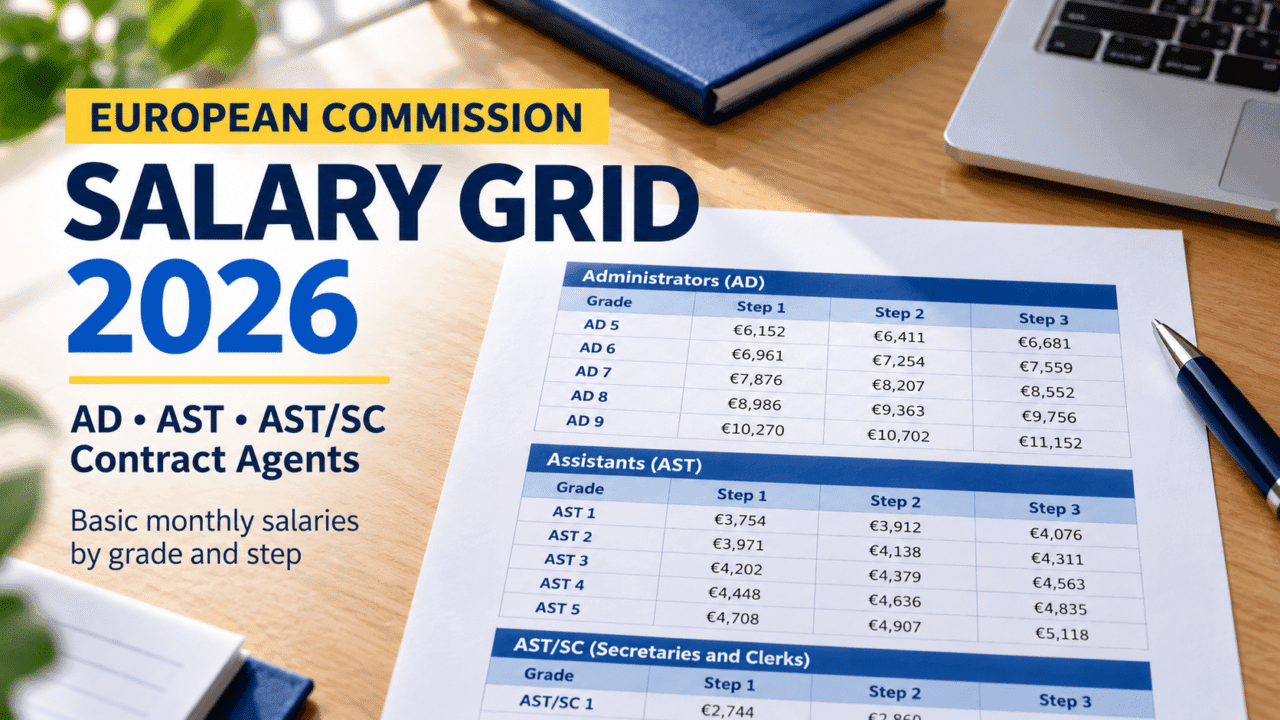
- Current Income Ceiling: Under the EU salary grid applicable from 1 July 2025, the basic monthly salary for grade AST 1, step 1 is EUR 3,754.39.
- Maximum Student Earnings: Forty percent of that baseline equals EUR 1,501.76 gross per month (for work carried out in Belgium or Luxembourg, where the coefficient is 100%). If your child works in another country, that EUR 1,501.76 threshold is multiplied by the Correction Coefficient of the country where the student works.

10. Special Family Situations, Disability Support, and National Grants
10.1. Divorced or Separated Parents
If you are divorced or legally separated and your former partner holds legal custody of your children, you remain entitled to claim the Preschool Allowance and the Education Allowance. You may instruct the PMO (or the PMO may act on a national court order) to transfer the allowance directly to the custodial parent’s bank account on your behalf.
When the Education Allowance is paid directly to a custodial former partner, an important calculation rule applies: both the 50 km distance threshold (for determining whether the single or double ceiling applies) and the Correction Coefficient are determined by the custodial parent’s place of residence, rather than your place of employment.
10.2. Children with a Disability
EU institutions provide three layers of support for parents of children with a documented disability or special educational needs:
- Doubling of the Education Allowance Within 50 km: If a disability prevents your child from attending a local European School, you can request the double Education Allowance (up to EUR 715.24 per month) under the “imperative educational reasons” rule, even if the specialised school your child attends is located less than 50 km from your place of employment.
- Doubling of the Dependent Child Allowance: Separately, under Article 67(3) of the Staff Regulations, the monthly Dependent Child Allowance (EUR 527.06 per month) may be doubled by a special reasoned decision of the appointing authority where medical documentation establishes that the child’s disability or chronic illness involves heavy financial expenditure.
- Supplementary Non-Statutory Support: Most EU institutions and agencies operate dedicated budget lines to reimburse disability-related educational, therapeutic, and assistive costs that are not covered by the statutory allowances or the Joint Sickness Insurance Scheme (JSIS). Parents should contact their HR social welfare service or the PMO directly for guidance.
10.3. Dual-Official Couples and Anti-Cumulation with Allowances from National Authorities
The EU Staff Regulations enforce strict anti-cumulation rules to prevent double financing of the same educational expenses:
- Both Parents Employed by EU Institutions: Where both parents are officials or agents of EU institutions or agencies, family allowances cannot be combined for the same child. The Education Allowance is paid to only one parent per child, even if the child’s private school tuition exceeds the monthly ceiling.
- Deduction of National Allowances and Student Grants: You are legally required to declare to the PMO any allowance of a similar nature received from national authorities or external bodies—such as state student maintenance grants, French allocations d’études or allocation de rentrée scolaire, Dutch basisbeurs (student finance grants), or Spanish becas de estudios. Any national grant received is deducted from your EU Education Allowance.
- Obligation to Claim National Benefits: The PMO actively monitors Member State family and education benefit schemes and expects EU staff to claim national allowances to which they are legally entitled in their country of employment or origin. If you would normally qualify for a national benefit in your host country or home country but do not receive it due to specific personal circumstances, the PMO may ask you to provide official proof of non-entitlement from the national authority before releasing the full EU Education Allowance.
11. How to Apply and Payslip Codes
All applications and annual declarations are submitted electronically to the PMO (or your agency’s HR department) through the Sysper human resources portal (an EU IT system available to most EU staff):
| Allowance Stage | Payslip Code | Application & Renewal Procedure in Sysper |
| Preschool Allowance | AEN / APS | Activated automatically when your child is registered as a dependent child in Sysper. No annual renewal or kindergarten invoice is needed until the child enters primary school (or reaches age 8). |
| Primary & Secondary Education Allowance | ISN | Must be declared every school year. Upload the EU school attendance form signed by the school representative, along with the school contract and itemized invoices/proofs of payment for registration, tuition, and transport. |
| Higher Education Allowance | ISF | Must be renewed every academic year. Upload the university’s official certificate of full-time enrollment and confirm in the declaration that any student income remains below the 40% AST 1/1 monthly ceiling. |
Whenever your family or your child’s educational circumstances change—such as interrupting or finishing studies early, changing schools, taking up employment above the income limit, or receiving a national grant—you must declare the change promptly in Sysper to avoid salary recoveries.
12. Sources
- Regulation No 31 (EEC), 11 (EAEC), laying down the Staff Regulations of Officials and the Conditions of Employment of Other Servants of the European Economic Community and the European Atomic Energy Community (Consolidated text as of 1 January 2026; see in particular Article 67, Annex VII Article 3, and Annex X Article 15).
- 2025 Annual Update of the remuneration and pensions of the officials and other servants of the European Union and the correction coefficients applied thereto (Official Journal of the European Union, C/2025/6564, 11 December 2025, applicable from 1 July 2025).
- Intermediate Update of the correction coefficients applicable from 1 January 2026 to the remuneration and pensions of officials and other servants of the European Union (Official Journal of the European Union, C/2026/3945, 23 July 2026).
- European Commission Decision C(2013) 8971 of 16 December 2013 laying down general implementing provisions on granting the education allowance under Article 3 of Annex VII to the Staff Regulations (documented in the Report from the Commission to the European Parliament and the Council on the rules adopted by the appointing authority of each institution to give effect to the Staff Regulations, COM(2026) 474).
I wrote this article to make it easier to understand the sometimes complex EU HR and administrative rules. However, your individual case might have unique angles due to prior work experience, family situation, or other factors.
Where to ask questions?
Rather than leaving a comment below, please bring your questions to our Jobs in EU Institutions Facebook Group. We have nearly 10,000 members there, including EU ‘insiders’, so you will receive a much faster and more thorough reply from me and the community.
Looking for weekly ‘Zero EPSO’ vacancies across EU institutions and daily tips?
Follow the Jobs in EU Institutions Facebook Page and join alongside over 6,000 other followers.Best regards, Ben
 Best regards, Ben



39 responses to “Education Allowance”
Hello, my ex husband is in Paris EU staff and me and my son in Athens, Greece. My son has been diagnosed with specific language impairment and although he is six years old he has to attend preschool again. (He also attends psychotherapy, logotherapy and ergotheroapy) The divorce is on the way and at the moment the only allowance i receive from his father is 620euros which I use to pay the school fees. PLEASE. Could you guide me on what are my son’s rights concerning allowances ect? Thank you very much in advance.
Nora, hi!
My reply is below, but please also post the question to our
*** Facebook group https://www.facebook.com/groups/jobs.in.eu.institutions ***
There are many competent people, including with divorce experience, who might add additional useful information.
DIRECT TRANSFER OF ALLOWANCES TO THE CUSTODIAL PARENT
Statutory EU allowances exist specifically for the child rather than as additional remuneration for the official. Under the EU Staff Regulations, once you hold an official court ruling or a formal separation agreement granting you custody, you can request that the Paymaster Office (PMO) pay your son’s statutory allowances directly into your bank account instead of transferring them to his father. Your divorce lawyer should explicitly incorporate this provision into the legal documents to provide the institution with unambiguous legal grounds to redirect the disbursements.
DEPENDENT CHILD ALLOWANCE AND SPECIAL FINANCIAL PROVISIONS
Your son might be entitled to a double dependent child allowance. The standard baseline dependent child allowance currently is €527.06. Article 67(3) of the Staff Regulations permits the Appointing Authority (the father’s institution, either the Director of the institution, or a persona s/he has delegated the right to) to double this dependent child allowance if a child has a recognized medical condition or disability resulting in heavy ongoing expenditure. The requirement for logotherapy, ergotherapy, and psychotherapy provides solid grounds for an application under this provision. I suggest to apply simultaneously to your ex-husband’s institution and PMO.
I am unable to tell you whether the allowance is calculated according to the correction coefficient for Paris or Greece. However, here are the relevant amounts.
Setting Correction Coefficient Standard Allowance (Base: €527.06) Doubled Allowance (Base: €1,054.12)
Brussels / Luxembourg (Base) 100.0% €527.06 €1,054.12
Father’s Duty Station (Paris, France) 113.6% €598.74 €1,197.48
Child/Mother’s Residence (Athens, Greece) 87.0% €458.54 €917.08
PRESCHOOL AND SPECIAL EDUCATIONAL SUPPORT
Regarding preschool tuition, the statutory education allowance under Annex VII, Article 3 is generally not payable until a child commences compulsory primary education. However, EU institutions maintain exceptional social and educational assistance frameworks for children with recognized special educational needs, which can provide financial support for specialized schooling or adapted educational care. You would have to address your ex-husband’s institution to inquire whether such support is in place. Policies for children with disabilities depend on the particular institution, and I cannot comment on Paris-based EU institutions, as this is too specific.
MEDICAL COVERAGE AND THERAPY REIMBURSEMENTS UNDER JSIS
Your son remains entitled to full coverage under the EU Joint Sickness Insurance Scheme (JSIS) as a dependent child of your husband, even though you are the primary caregiver. JSIS reimburses recognized paramedical treatments—including speech therapy, occupational therapy, and psychotherapy—typically at 80% up to statutory ceilings. Paramedical therapies might require prior medical authorization (entente préalable) from the JSIS settlements office, meaning the father must promptly upload the prescriptions issued by your medical specialists to obtain formal reimbursement approval.
You also should ask him to inquire with PMO directly whether your son qualifies for something called “serious medical condition” as in this case, the reimbursement is 100% of the cost. You should also know that there is the possibility of direct payment between the PMO and the healthcare institution, provided this is arranged in advance. This would allow you to avoid large out-of-pocket payments and waiting for PMO reimbursement.
I sincerely hope that your ex-husband is cooperating with you on child care-related matters, because I unfortunately do not know what happens if the former spouse refuses to cooperate. Because of this, it is extremely important to record any communication, preferably in writing, but also by recording phone conversations. That way, in case the ex-spouse does not cooperate, you can try to investigate the possibility of direct submission of expenditure on the JSIS portal for reimbursement.
PRACTICAL NEXT STEPS
1. Get in touch (in writing) with your former spouse’s institution’s HR division and inquire about your rights as the primary caregiver of the child of the institution’s staff member.
2. Meticulously document all medical assessments and procedures. You should obtain detailed clinical evaluations from your son’s specialists specifying the exact diagnosis, therapy schedule, and educational requirements, etc. Ensure the father submits these prescriptions to JSIS for prior authorization and formally requests an Article 67(3) assessment through his institution’s medical service for the doubled dependent child allowance. Inquire with PMO whether you can submit the medical expenses related to your child’s healthcare directly yourself.
3. In parallel, instruct your legal counsel to finalize the custody judgment specifying the direct allocation of EU family allowances to you, which can then be served directly to the PMO.
While the above might seem relatively exhaustive, still please post the question on the Facebook page because people with practical experience might provide additional key details.
Ben,
I so am thankful for all the information you have provided me. I really have no access on the rights of my child. Please, could you explain to me more thoroughly what is the double allowance and if my child is candidate for it? I have been informed that until the 6th year the child allowance is 505 euros plus the pre-school allowance of 128 euros.
Regarding the double allowance, you must collect all relevant medical information about your child’s health condition and submit it to the PMO for evaluation. The PMO will determine whether you are entitled to double dependent child allowance due to the health challenges you are facing. As far as I know, this is usually done by submitting the information to the institution’s HR, which would typically be done by your husband. You can explore whether you can contact the institution’s HR yourself directly, and then they submit it to the PMO on your behalf.
Please kindly ask the question in the Facebook group because there is a very high chance that people might also suggest some other relevant further steps.
There is a possibility to ask questions anonymously, so you will not have to reveal your Facebook account identity.
What is the situation if you go to work for an EU delegation inside the EU? I am thinking specifically of Rome, as a temporary agent. There is no European School but the cost of an English language education would be circa 20k a year, much higher than the educational allowance. Would the assistance still be limited to the double education allowance (circa 7.5k)? Thank you!
In case there is not a special arrangement, then indeed you just put double indication allowance. However, most EU institutions in EU cities where there is no European school have internal rules to significantly top up the education allowance to cover low- to medium-cost educational establishments.
If you plan to apply, this support is important to you. Before applying, contact the HR of the relevant institution and ask a question. This would be an absolutely normal practice for a possible future employee.
Hello! I have a question regarding double allowance. I am studying my master in the Netherlands while my father (worker of EU Parliament brussels) receives the student grant there.
If I received the DUO student grant from the Netherlands, which includes free transport for students, would it be considered double allowance?
Hello,
My daughter, 25 years old, has finished her studies at the age of 24. Her education allowance were then not received any more, but now she is starting another University degree. Is she entitled to receive again the education allowance until the age of 26?
I’d say yes.
I confirm what X says. You’re entitled until she turns 27.
Hello.
Is the education allowance applicable to universities outside the EU and EEA (ex: Canada, China…)?
Hi! I have two questions:
– Why do 12 monthly installments allow to receive a larger education allowance (red box)? I thought that annual costs were relevant to determine the education allowance. Would this mena that making 1 single payment for the tuition fees of the whole year would lead to a lower education allowance?
– In case both parents are EU officials, following the measures to avoid double-financing only one education allowance is paid regardless of the total school costs, right?
Thank you!
Mike, hi!
1. There is a monthly limit to the allowance. Hence, if you pay in 9 or 10 months, you loose 2-3 months of the allowance. No problem to make one single fee payment, but make sure to include a clause in the contract that it’s for 12 months to avoid issues with the PMO.
2. Yes, that’s correct.
Hello, for the education allowance: my son just started primary school this year. He is going to a normal public school with no school fees as such, I just have to pay for the lunch and the childcare for Wednesday afternoon. He walks to school, no transportation costs. Do I understand it correctly that in this case I will not get any education allowances at all? In this case, I don’t even have to start a request and register my school confirmation in Sysper, right ? do not really understand why I got allowances for the kindergarden until this summer where it was a public kindergarden he could walk to as well and now at school we do not get any allowances at all? Do not really understand the rational behind this thinking, can someone help please ?
Hi! I was also recently wondering about the same thing – whether I should try to claim at least the transportation costs for one of my kids who goes to a public school. I don’t have a good response. I hope someone with more experience or HR knowledge can provide a better reply!
Hello Ben,
As per the Staff Regulations, my parents (based in Brussels) receive the education allowance. I am currently studying in Switzerland and working part-time to cover my tuition fees and living costs, which are higher here. According to the Education Allowance Rules, the child’s part-time monthly salary must be less than 40% of the basic salary of an AST1/1, adjusted by the weighting of the country where the work is performed.
1. Would you be able to clarify which Education Allowance coefficient is applicable in my case: is it based on where I work (Zurich) or where my parents work (Brussels)?
2. Additionally, what is the maximum amount I can earn in 2024, and is the threshold refer the to gross or net amount of my earnings?
3. Where can I find the applicable regulations text?
Thank you in advance and best regards.
Hi! Your parents can get a 100% binding reply from their institution’s HR. However, here’s what I can immediatelly share:
1. After consulting the Staff Regulations, I’m fairly certain the Correction Coefficient is calculated according to the place of residence of the parent who received the allowance. Do a search for ‘education allowance’ in the SC text, there are only 12 instances so you’ll quickly be able to see all the conditions.
2. AST1/1 amoung for 2024 is EUR 3461,58 (Source is Article 66 of the 2024 Staff Regulations edition). This means you can’t officially earn more than EUR 1384.60. As your parents work in Brussels, this will be the final amount as CC for Brussels is 100%.
3. See reply to NO. 1.
Hello,
Will my 23 year-old-daughter receive any allowance when doing her poorly remunerated medical internship (5-year specialisation)? Does it count as work or as education? Thank you
I believe this counts as education. Please see my response to Rain.
If a child enrolled in an Italian university is admitted to an international mobility extra EU of 6 months in UK
Can I be entitled to double flat rate of education allowance with no deduction of grant fir mobility ?
Hi
I work in Luxemburg and my kids will go to university in holland and Portugal ( home country)
Can i claim double allowance for both who will stay in university residences?
The request for the allowance is the same as for the Education allowance for school-aged children. If unsure how to proceed, please contact your institution’s HR department/unit.
Hi,
I am posting this here because I cannot find a more relevant blog post so far on this topic: I do not find information in the staff regulations regarding contract agents and maternity. If a woman gets pregnant while being employed in a CAST position, what would be the rules? How long can she stay away from work? Is she entitled to financial support during this period? If she is still home with the child when the contract ends, what then? If you have any information on that, I’d appreciate it a lot! Thank you.
Hi! General rules applicable to all staff members apply in this position. As I haven’t researched this question in detail, I would abstain from giving specific tips. I suggest you do two things: 1) ask HR about the applicable rules, 2) consult other colleagues who’ve been on maternity in your institution. While the rules are uniform, their application might slightly differ by institution. Colleagues who’ve been on maternity leave might advise you how to stay with your child at home the longest, while also receiving most of the benefits. Here the devil is really in the details and someone who has gone through this sometimes Kafka-esque process might really give you tips worth their weight in gold (or actually hundreds of euros).
Thank you for this precious piece of information.
Any chances you may know where these amounts come from (282€ for Brussels) as they do not really make sense. As a matter of fact, with roughly 3,000€/year there is no way it will cover any fees for any private schools so we are forced to enrol our kids in the European School’s system that is not ideal for everyone.
Thank you in advance
Indeed, the institutions want to force you to enroll your kids in a European School if there is one.
For EU institutions outside Brussels and Luxembourg, and where there is no EU school, one by default gets double the Education allowance, and often there are much higher reimbursement limits stipulated in the particular EU institution’s ‘seat agreement’ with the hosting Member State which most often reimburse actual school costs. These usually remain in place until an Accredited European School is established. Locations of Accredited European Schools: https://www.eursc.eu/en/Accredited-European-Schools/locations.
Hi Ben!
I’m divorced male with 2 kids. I’m moving from one country to another and kids will stay with my ex-wife. They will be more then 1000km from me. Both are in regular school.
Also, I’m married (yes, again) and she have a kid (not mine).
Will I get any education allowances or some extra kids money, which I can send to my kids? And may be potentially get a place in school for new wife kid?
Thank you!
Hi! Please consult a professional lawyer to get a definitive reply, or at least consult your EU institution’s HR department.
With this formality out of the way, here are my thoughts on the matter –
If you remain the official parent of kids from first marriage and your wife does not also work at an EU institution (or receive a similar allowance from a similar institution like a UN agency), and your 1st wife’s current partner has not adopted your kids, you should be entitled to the dependendt child allowance as well as education allowance for both kids (provided that they are in a fee paying school or incur other expenses that can be reimbursed from the edudation allowance).
Regarding the child in your new marriage, this is something you would have to ask your new institution’s HR department. If you would have adopted the child, you would be entitled to the same rights as for your biological children. If you are in a marriage with the child’s mother, but have not adopted the child, I am unable to commment on your entitlements.
It would be very kind if you could share here or over email if your current spouse’s child also entitled you to the dependent child allowance and education allowance so that I can update the article with this situation!
Very informative, thank you. Does the Commission have nurseries for children of staff (in Brussels)? I see that the Parliament and Council do, and it shocks me that the Commission doesn’t, since it likely employs much more people.
Pablo, as far as I know all EU institutions staff are treated equally and the Commission should not be inferior to the Council or the EP.
Please look into this some more, contact your institution’s HR. If it really turns out that creches/ nurseries/ kindergardens are not as widely available to COM staff as to other institutions, please let me know and I’ll be happy to add this to the article so that people are informed and know what to expect when moving to Brussels.
Hello,
I am a master’s student studying in The Netherlands. As my father works at the European Commission in Brussels, we benefit from the education allowance. My question is: if I take a student job (8hrs/week paid), will we still be granted the education allowance?
Thank you for your help.
Hi, if you are above 18 and<26 years old your parent(s) keep(s) their allowance for as long as you don't earn more than 40% of an AST1/1 equivalent salary.
Hello Ben,
I would like to ask your advice on what to do. The private school that I enrolled my child has a discount for a lump-sum payment for the annual fees. If I request for 12 installments, I am going to lose this discount, which is quite big. What can I do?
Thanks in advance.
Hi! You should talk to your HR or the entity that deals with the Education Allowance and negotiations with local schools. Also – talk to colleagues, as older colleagues might have already experienced a similar issue. Staff committee is another good source.
However, it is possible that you might be unable to benefit form the single payment discount.
Good afternoon,
I am moving from one EU agency to another EU agency starting with 1 May 2022. My kids will stay to finish the school and now the current EU agency will charge me for the remaining 2 months of the school. I would like to know what are the rules in this type of situation.
Thank you!!
In the worst case scenario, you will be entitled to the Education allowance (single or double amount, depending on whether there’s an EU school in your new employment location / 283,82 or 567,64 EUR * Correction coefficient).
In the best case scenario, you should enquire with your new agency whether they can under a normal or exceptional procedure to cover the costs of your kids school.
Hello, thank you for the extensive explanations. Let’s assume that I don’t want to send my kid to the European School in Warsaw while working at Frontex, but to another international school paid for from my own pocket. Am I eligible for the education allowance? Thank you.
Hi! I understand from other readers that the European School in Warsaw recently opened and does not have all 12 grades available. Hence, if your child is eligible to a place in the local European School (i.e., the necessary grade/year is open), you are entitled to a single Education Allowance. If your child does not have a place in the European School, you are entitled to a double allowance. This is under the assumption that your place of work is Warsaw. The same would apply to any other EU city. More precise details can be obtained from your HR department.
If you find out a details that’s not covered in the article and my comment, could you please let me know so that I can update the content? Thanks!