

Last updated 16 October 2026.
This article explains salaries at Frontex, the European Border and Coast Guard Agency, headquartered in Warsaw, Poland. It compares remuneration across four personal and family situations and explains the difference between basic salary, allowances and take-home pay.
Key takeaways
- Poland’s correction coefficient is 82.3%. This means your salary will be roughly 17% lower than for an identical contract in Brussels.
- Basic salary is not take-home pay. Frontex staff don’t pay national salary taxes, however, there is an EU tax and statutory deductions from your salary. There are also a number of allowances that can substantially increase your salary, particularly, for expats and staff with families.
- Payments to Standing Corps during deployments in the field should be assessed separately.
Introduction
Understanding a Frontex job offer requires more than finding the basic salary for a particular grade. You also need to know your step, the geographical weighting, your allowance entitlements and the deductions applied to your remuneration.
Frontex provides useful salary information in its recruitment notices. Its official remuneration page states that salaries posted in vacancy announcements are net of taxes and compulsory contributions. However, a vacancy’s basic net-pay figure is not necessarily the final amount payable to an employee with family or expatriation allowances.
About Frontex
Frontex is an EU institution that promotes, coordinates and develops European border management and institutions responsible for this function in EU Member States and Schengen-associated countries.
The agency also facilitates the uptake of the concept of Integrated Border Management. Frontex also engages in a multitude of other border guarding-related functions such as monitoring migration flows, carrying out vulnerability assessments of Member States institutions, organises joint operations and rapid border interventions, carries out search and rescue at operations at sea. Frontex also supervises Standing Corps, the EU’s border guard service.
The agency offers headquarters roles in areas such as policy, law, finance, procurement, human resources, project management and intelligence analysis. Standing Corps officers have more than 10 different professional profiles; most Standing Corps officers are deployed in the field at European Union borders with third countries, more recently also in third countries (e.g., Western Balkan countries). In rarer cases, they can also be assigned to the headquarters in Warsaw or deployed to airports in EU member states.
Salaries
Unlike most EU institutions and agencies where candidates must decipher complex salary grids on their own, Frontex stands out positively for its pay transparency. When publishing specific job notices, the Agency usually provides relatively detailed monthly net take-home calculations in both Euros (EUR) and Polish Złoty (PLN).
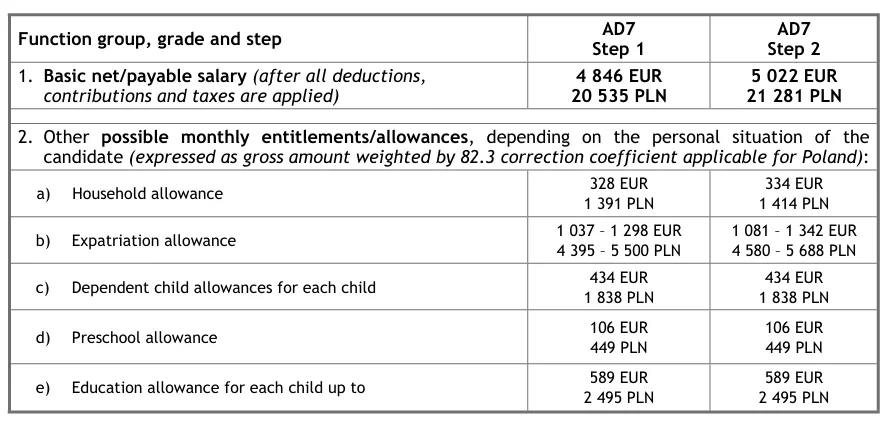
However, for most outsiders, calculating the exact take‑home pay is difficult, and this guide addresses it.
Net pay calculation examples
To demonstrate how allowances and deductions interact in practice, the breakdown below models an entry-level Administrator AD 5, Step 1 (the standard entry benchmark for university graduates entering Frontex with a basic salary of €5,973.44).
The table shows both the unadjusted baseline components (Brussels 100% equivalent) and the final net take-home remuneration deposited into your bank account after applying the 82.3% Polish Correction Coefficient:
| Remuneration Element | Situation 1: Single Local (No Children) | Situation 2: Married Local (2 Children) | Situation 3: Single Expat (No Children) | Situation 4: Married Expat (2 Children) |
|---|---|---|---|---|
| Basic Salary (AD 5, Step 1) | €5,973.44 | €5,973.44 | €5,973.44 | €5,973.44 |
| Household Allowance (€241.21 + 2%) | €0.00 | €360.68 | €0.00 | €360.68 |
| Dependent Child Allowance (2 kids) | €0.00 | €1,054.12 | €0.00 | €1,054.12 |
| Expatriation Allowance (16%) | €0.00 | €0.00 | €955.77 | €1,189.43 |
| Pension Contribution (13.1%) | -€782.52 | -€782.52 | -€782.52 | -€782.52 |
| Sickness Insurance (JSIS, 1.7%) | -€101.55 | -€101.55 | -€101.55 | -€101.55 |
| Accident Insurance (0.1%) | -€5.97 | -€5.97 | -€5.97 | -€5.97 |
| EU Community Tax (Indicative) | -€436.00 | -€186.00 | -€436.00 | -€186.00 |
| Special Solidarity Levy (6%) | -€114.00 | -€114.00 | -€114.00 | -€114.00 |
| Total Net Pay (Brussels 100% baseline) | €4,673 | €6,263 | €5,618 | €7,208 |
| Polish Correction Coefficient | 82.3% | 82.3% | 82.3% | 82.3% |
| ESTIMATED NET TAKE-HOME PAY (WARSAW) | €3,846 | €5,154 | €4,624 | €5,932 |
N.B. These calculations are indicative and based on statutory rules. Only Frontex’s Human Resources unit can calculate your exact individual figure upon reviewing formal supporting documentation (marriage certificates, children’s school status, and previous residence history).eat that your precise salary can be calculated only by the EU institution’s HR department that knows your particular professional and personal circumstances.
What is deducted?
Current published EU agency remuneration guidance lists the following contributions:
| Deduction | Published rate |
|---|---|
| Pension | 13.10% |
| Sickness insurance | 1.70% |
| Accident coverage | 0.10% |
| Unemployment insurance | 0.51% |
| EU income tax | Progressive calculation |
| Solidarity levy | 6% |
The percentages should not simply be added together and applied to the gross total: the calculation bases, tax deductions and levy rules matter. Family allowances are excluded from the basic taxable amount, and dependent children attract additional tax deductions.
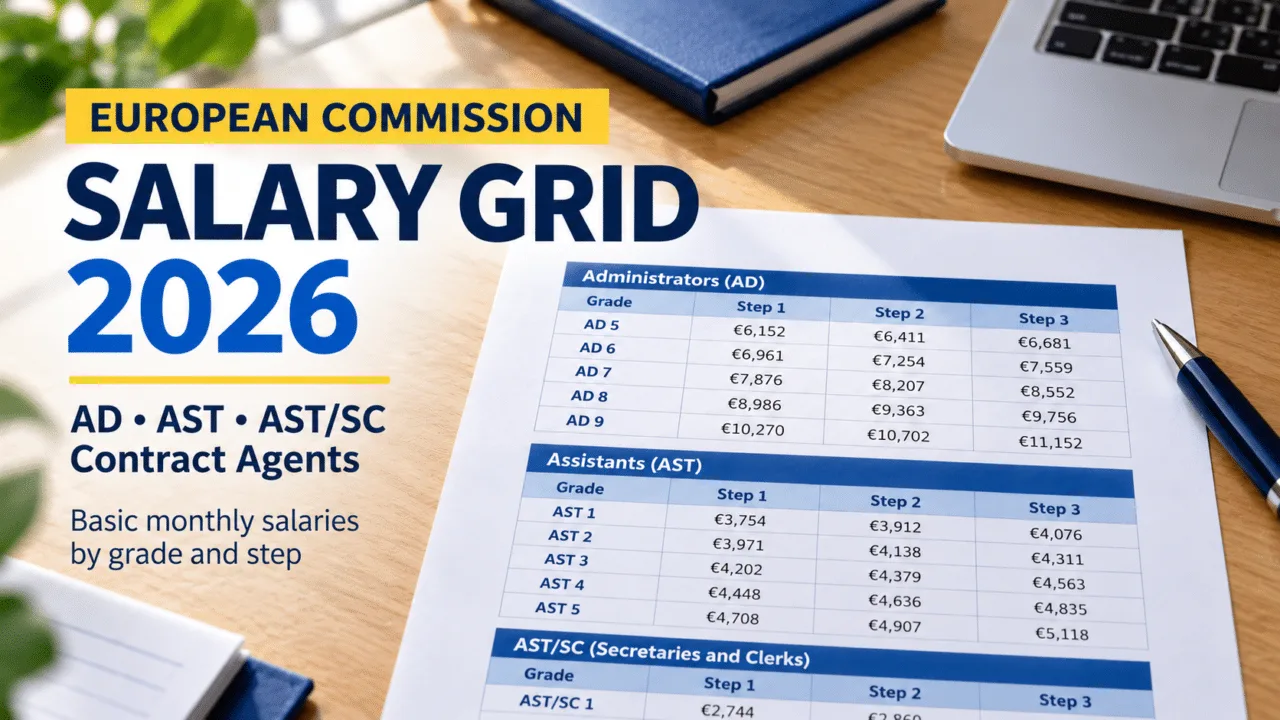
Read this article to find out the ‘basic salary’ scales for all types of contracts in EU institutions.
The Role of Poland’s Correction Coefficient
Under Article 64 of the EU Staff Regulations, staff salaries are weighted by a Correction Coefficient to guarantee equal purchasing power across all EU duty stations regardless of local living costs. Brussels and Luxembourg serve as the base benchmark at 100%.
| Location / Duty Station | EU Body / Agency | Correction Coefficient (Cost-of-Living Weighting) |
|---|---|---|
| Brussels / Luxembourg | European Commission / Council / EP | 100.0% (Baseline) |
| Warsaw, Poland | Frontex | 82.3% |
| Vilnius, Lithuania | EIGE | 87.4% |
| Riga, Latvia | BEREC Office | 84.3% |
| Tallinn, Estonia | eu-LISA HQ | 95.0% |
| Copenhagen, Denmark | EEA | 130.5% |
From 1 July 2025 until at least the end of 2026, the Correction Coefficient for Poland (Warsaw) is set at 82.3%. This means that gross basic salary components and certain family allowances are multiplied by 0.823 on your payslip (in other words, decreased by around 17% compared to Brussels).
| Example, Step 1 | Brussels Reference Basic Salary | Weighted Warsaw Basic Salary (82.3%) | Monthly Difference |
| FG IV, Grade 13 | €4,319.72 | €3,555.13 | −€764.59 |
| FG IV, Grade 14 | €4,887.55 | €4,022.45 | −€865.10 |
| AD 5 | €5,973.44 | €4,916.14 | −€1,057.30 |
| AD 6 | €6,758.53 | €5,562.27 | −€1,196.26 |
| AD 8 | €8,651.92 | €7,120.53 | −€1,531.39 |
additional allowances for Standing Corps officers
For Frontex statutory staff deployed in operational activities (Category 1 Standing Corps, but also Category 2-4 Standing Corps officers delegated by member states), basic salary represents only a portion of total monthly remuneration. Deployed officers qualify for specific statutory allowances and expense reimbursements governed by the EU Staff Regulations and dedicated Frontex Management Board decisions.
1. Mission and Daily Subsistence Allowances
When deployed away from their place of employment (normally Warsaw) to operational areas along EU external borders or in third countries, Standing Corps officers receive daily subsistence allowances (DSA) and accommodation cost coverage.
- Short-Term Operational Missions: The daily allowance covers meals and incidental local expenses:
- Daily Subsistence Allowance (DSA): Ranges country-by-country from approximately €78 to €172 per day (e.g., €78 in Bulgaria, €102 in Greece, €116 in Spain, €172 in Denmark).
- Accommodation: Hotel costs are reimbursed against actual invoices up to the maximum country-specific ceiling (typically between €115 and €230 per night), or arranged directly by Frontex.
- Long-Term Operational Deployments: For extended field deployments (typically exceeding 30 to 60 consecutive days), Frontex applies specific rules based on a Management Board decision. The daily allowance in longer-term deployments is adjusted downward to reflect fixed temporary accommodation costs (often reduced to a range of €60 to €110 per day depending on the “operational theatre”).
2. Shiftwork Allowance
Standing Corps officers engaged in operational shift cycles (including round-the-clock rotations at border crossing points, naval assets, and control rooms) are entitled to a flat monthly shiftwork allowance. The allowance is paid as a fixed monthly sum determined by the specific shift pattern:
| Shift Pattern | Schedule Description | Indicative Monthly Allowance (Gross) |
| Rate 1 | Two alternating shifts (excluding nights and weekends) | ~€480 – €510 |
| Rate 2 | Two shifts including nights, Sundays, and public holidays | ~€720 – €765 |
| Rate 3 | Continuous 24/7 rotation without night shifts (or alternating day/weekend shifts) | ~€790 – €840 |
| Rate 4 | Full continuous 24-hour service covering 3–4 shifts, including nights and weekends | ~€1,070 – €1,140 |
3. Standby Duty Allowance
When required to remain available on-call outside standard working hours for emergency border interventions, rapid deployment teams, or search and rescue alerts, officers qualify for a standby allowance. Compensation is calculated using an EU-wide points system:
- Point Value: Each point equals 0.032% of the basic monthly salary of an official in Assistant Grade 1, Step 1 (~€1.20 gross per point under recent updates).
- Standby at Home:
- Working days: 2.15 points per hour (~€2.58/hr).
- Weekends and public holidays: 4.30 points per hour (~€5.16/hr).
- Standby at the Workplace:
- Working days: 11 points per hour (~€13.20/hr).
- Weekends and public holidays: 22 points per hour (~€26.40/hr).
Indicative Monthly amount:
- A typical operational rotation requiring one weekend on call at home (approx. 48 hours) yields ~206 points, adding ~€250 gross.
- A combined monthly schedule of 60 hours of weekday standby at home plus two weekends (approx. 156 total hours) yields ~540 points, adding roughly €650 gross.
- High-readiness workplace standby can generate €1,000 to €1,800+ gross depending on the number of non-working hours covered.
Contract Agent (CA) Salaries at Frontex
Frontex employs a significant number of Contract Agents under Article 3a of the CEOS for headquarters support, operational work, returns coordination, and practical field logistics. Below are typical entry benchmarks across the CA function groups:
| Function Group & Typical Entry Grade | Basic Salary (Brussels 100%) | 01: Single Local (No Children) | 02: Married Local (2 Children) | 03: Single Expat (No Children) | 04: Married Expat (2 Children) |
|---|---|---|---|---|---|
| FG I (Grade 1, Step 1) | €2,537.59 | €1,745 | €2,749 | €2,049 | €3,226 |
| FG II (Grade 4, Step 1) | €2,635.66 | €1,802 | €2,806 | €2,124 | €3,308 |
| FG III (Grade 8, Step 1) | €3,374.39 | €2,271 | €3,367 | €2,684 | €3,959 |
| FG IV (Grade 13, Step 1) | €4,319.72 | €2,856 | €4,041 | €3,407 | €4,773 |
| FG IV (Grade 14, Step 1) | €4,887.55 | €3,195 | €4,453 | €3,831 | €5,268 |
Note: For Contract Agents, previous professional experience dictates whether you start in Grade 13 (under 5 years) or Grade 14 (5 to 17 years) in FG IV, or Grade 8 versus Grade 9 in FG III.
Administrator (AD) Salaries at Frontex
The table below reflects the monthly basic salary (Step 1) and the estimated monthly net take-home remuneration for Administrators in Warsaw after applying all statutory deductions, allowances, and the 82.3% Correction Coefficient.
| Grade (Step 1) | Basic Salary (Brussels 100%) | 01: Single Local (No Children) | 02: Married Local (2 Children) | 03: Single Expat (No Children) | 04: Married Expat (2 Children) |
|---|---|---|---|---|---|
| AD 5 | €5,973.44 | €3,846 | €5,154 | €4,624 | €5,932 |
| AD 6 | €6,758.53 | €4,247 | €5,605 | €5,111 | €6,465 |
| AD 7 | €7,646.86 | €4,788 | €6,208 | €5,784 | €7,040 |
| AD 8 | €8,651.92 | €5,290 | €6,996 | €6,464 | €8,064 |
| AD 9 | €9,789.10 | €5,848 | €7,430 | €7,110 | €8,767 |
| AD 10 | €11,075.76 | €6,379 | €8,049 | €7,753 | €9,646 |
| AD 11 | €12,531.47 | €6,997 | €8,781 | €8,551 | €10,528 |
| AD 12 | €14,178.56 | €7,695 | €9,630 | €9,432 | €11,539 |
| AD 13 | €16,042.15 | €8,470 | €10,561 | €10,401 | €12,656 |
| AD 14 | €18,150.61 | €9,247 | €11,475 | €11,376 | €13,772 |
| AD 15 | €20,536.29 | €10,128 | €12,506 | €12,487 | €15,030 |
| AD 16 | €23,235.49 | €11,276 | €13,662 | €14,074 | €16,790 |
Assistant (AST) Salaries at Frontex
Assistants at Frontex manage technical logistics, procurement, operational coordination centres, ICT infrastructure, and flight coordination. Grades range from entry-level AST 1 up to senior technical coordinators at AST 11.
| Grade (Step 1) | Basic Salary (Brussels 100%) | 01: Single Local (No Children) | 02: Married Local (2 Children) | 03: Single Expat (No Children) | 04: Married Expat (2 Children) |
|---|---|---|---|---|---|
| AST 1 | €3,645.04 | €2,444 | €3,570 | €2,886 | €4,214 |
| AST 2 | €4,124.14 | €2,736 | €3,922 | €3,244 | €4,643 |
| AST 3 | €4,666.18 | €3,061 | €4,308 | €3,649 | €5,118 |
| AST 4 | €5,279.52 | €3,433 | €4,741 | €4,106 | €5,646 |
| AST 5 | €5,973.44 | €3,846 | €5,154 | €4,624 | €5,932 |
| AST 6 | €6,758.53 | €4,247 | €5,605 | €5,111 | €6,465 |
| AST 7 | €7,646.86 | €4,788 | €6,208 | €5,784 | €7,040 |
| AST 8 | €8,651.92 | €5,326 | €6,804 | €6,460 | €7,999 |
| AST 9 | €9,789.10 | €5,848 | €7,430 | €7,110 | €8,767 |
| AST 10 | €11,075.76 | €6,379 | €8,049 | €7,753 | €9,646 |
| AST 11 | €12,531.47 | €6,997 | €8,781 | €8,551 | €10,528 |
Secretaries and Clerks (AST/SC) Salaries at Frontex
The AST/SC staff category provides executive secretarial support, document registry, operational archiving, and administrative services across Frontex divisions. New recruits enter primarily at AST/SC 1 or AST/SC 2. Use of this contract type appears to be very limited at the Frontex.
| Grade (Step 1) | Basic Salary (Brussels 100%) | 01: Single Local (No Children) | 02: Married Local (2 Children) | 03: Single Expat (No Children) | 04: Married Expat (2 Children) |
|---|---|---|---|---|---|
| AST/SC 1 | €3,196.06 | €2,171 | €3,244 | €2,552 | €3,819 |
| AST/SC 2 | €3,616.12 | €2,425 | €3,546 | €2,863 | €4,186 |
| AST/SC 3 | €4,091.41 | €2,712 | €3,894 | €3,216 | €4,614 |
| AST/SC 4 | €4,629.18 | €3,037 | €4,280 | €3,621 | €5,085 |
| AST/SC 5 | €5,237.60 | €3,404 | €4,713 | €4,073 | €5,608 |
| AST/SC 6 | €5,926.03 | €3,814 | €5,118 | €4,586 | €6,079 |
Work culture
It is notoriously difficult to obtain information about the work culture in a particular EU agency. The best source that I’ve found is to consult the relevant GlassDoor page for the respective EU institution. This is a GlassDoor page about Frontex. You should also definitely join one of the several Facebook groups dedicated to Frontex Standing Corps, for example, this one.
All articles in the series “Salaries in EU institutions”
In you are interested in more information about the Standing Corps, read the dedicated articles for each European Union border guards employment category:
>> How to become a Frontex border guard?
>> Salary and benefits – European Border and Coast Guard Officer, Basic Level (Contract Agent FGIV)
>> Salary and benefits – European Border and Coast Guard Officer, Intermediate Level (Assistant AST4)
>> Salary and benefits – European Border and Coast Guard Officer, Advanced Level (Administrator AD7)

Allowances and other benefits for EU institutions staff
Several allowances and other benefits can quite significantly boost an EU official’s income. This largely depends on whether the person is an expat and has a spouse and/or children. When considering a job at an EU institution, people too often do not take these benefits into account. Important – these benefits are available to Administrators in grades AD 5-16, Assistants in grades AST 1-11, Secretaries and Clerks in grades AST/SC 1-6, and Contract Agents in grades FG I-IV.
- Travel costs on taking up duties.
- Daily subsistence allowance. Paid during your initial onboarding period if you must change your residence to take up duties in Vilnius. Staff entitled to the household allowance (staff with a spouse or/and dependents) receive €55.40 per calendar day for up to 10 months (probation period plus one month). Staff without household allowance receive €44.68 per calendar day for 120 days.
- Installation allowance and coverage of removal costs (one-time payments). A lump sum granted upon completing your probationary period when moving your domicile. Single staff receive one month’s basic salary (minimum statutory floor of €937.77 for contract agents / €1,577.18 for temporary staff/officials). Staff relocating with family receive two months’ basic salary (minimum €1,577.18).
- Expatriation allowance or Foreign Residence allowance. Paid under Article 4 of Annex VII to officials who are not nationals of their host country and have not habitually resided or carried out their main occupation there during the five years ending six months before entering the service. It equals 16% of the sum of basic salary, household allowance, and dependent child allowances. Expats who are not entitled to the expatriation allowance get a foreign residents allowance that equals 4% of the basic salary amount.
- Household allowance. Calculated as a flat base of €241.21 plus 2% of basic salary for married officials, registered non-marital partners, or single parents with dependent children.
- Dependent child allowance. A flat payment of €527.06 per month per child, granted automatically up to age 18, or up to age 26 while the child is in full-time educational or vocational training.
- European School enrollment for children or Education allowance. Children of EU institutions staff enjoy free tuition at local European Schools. Where no European School is available, or for pre-school and university attendance, staff receive a statutory Education Allowance of €357.62 (subject to the correction coefficient). In certain cases, the education allowance is doubled to €715.24 per child per month.
- Healthcare costs reimbursement to a level of 80-85% through the EU’s Joint Sickness Insurance Scheme (JSIS) for the employee and any direct family members and dependents. 100% reimbursement of costs in case of a serious illness.
- Accident insurance.
- Annual travel grant. An annual flat-rate payment assisting expatriate staff and family members with travel to their official place of origin. Calculated based on kilometric distance (e.g., €268.04 for distances between 600 km and 1,200 km, and €536.00 for distances exceeding 1,200 km, with additional per-kilometre weighting).
- Birth & adoption grant.
- Parental leave allowance. Statutory leave grant of €1,289.65 per month (or €1,719.56 per month for single parents) during approved parental leave.
- Unemployment allowance.
- Removal expenses when leaving your home country and again when leaving your EU institution.
- EU pension, survivors and orphan’s pensions, invalidity allowance.
- Lump sum payments in case of permanent invalidity or death.
- Lump sum funeral expenses. Costs incurred upon the death of an official, their spouse, or dependent child are reimbursed up to a statutory ceiling of €3,365.18. If death occurs while on official mission, the costs of repatriating the body to the official’s place of origin are fully covered by the institution.
- Invalidity & Survivor Pensions: Comprehensive life, disability, and death social security/coverage. In case of accidental death related to duties, a lump sum of 5 times the annual basic salary is paid to eligible beneficiaries, with invalidity and orphan pensions ensuring partial income continuation.
I wrote this article to make it easier to understand the sometimes complex EU HR and administrative rules. However, your individual case might have unique angles due to prior work experience, family situation, or other factors.
Where to ask questions?
Rather than leaving a comment below, please bring your questions to our Jobs in EU Institutions Facebook Group. We have nearly 10,000 members there, including EU ‘insiders’, so you will receive a much faster and more thorough reply from me and the community.
Looking for weekly ‘Zero EPSO’ vacancies across EU institutions and daily tips?
Follow the Jobs in EU Institutions Facebook Page and join alongside over 6,000 other followers.
Best regards,
Ben





2 responses to “Frontex Salaries”
Hello,
I am trying to find the regulations that establish shift allowance for two shift workers on the field, who often work morning and afternoon as well as weekends and public holidays.
The guidelines and journal I have found is not that clear regarding the regulations
I would appreciate a clear answer regarding this.
Thank you very much for this awesome website.
Hi! This seems to be a very Frontex-specific thing, and not something where the European Commission would provide overall rules. Please get in touch with Frontex HR about this.